Anthracnose
A group of fungal leaf and shoot diseases that arrive in cool wet springs, disfigure the first flush of foliage, and are almost always over by midsummer. Alarming to look at on a sycamore, and very rarely a threat to an established tree.
Mostly cosmetic. Ugly, sometimes alarming, and almost never a threat to the tree's life. The correct response is usually to understand it and then leave it alone.
What you see
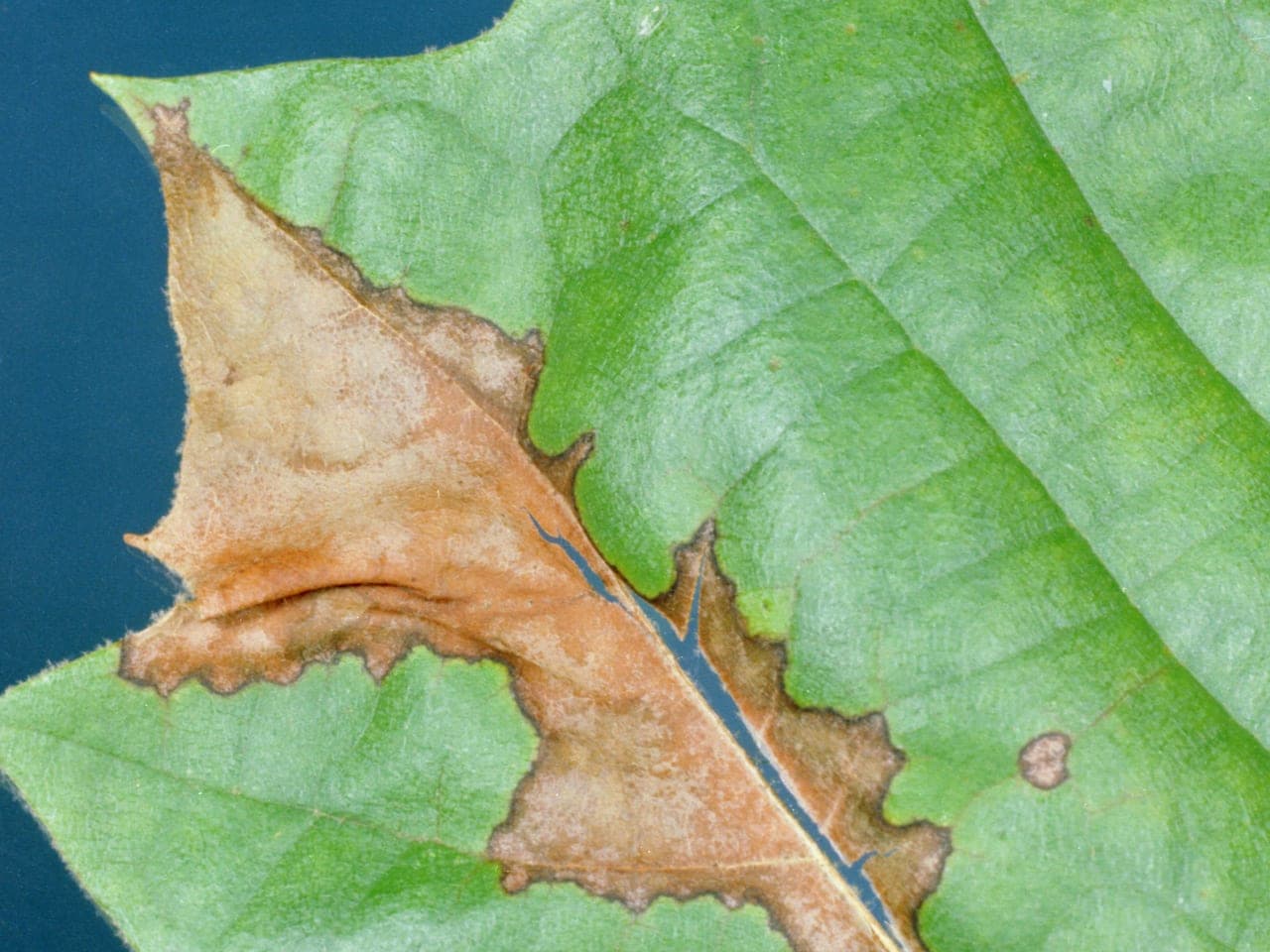
- Irregular brown or tan blotches on leaves, following the veins rather than forming neat circles
- Young shoots blackening and dying back in spring
- Heavy leaf drop in May and early June, sometimes defoliating a tree almost completely
- A second flush of clean new leaves appearing by late June
- Small cankers on twigs, and over years a clustered witches'-broom growth habit on sycamore
- Worst on the lower and inner canopy where the foliage stays wet longest
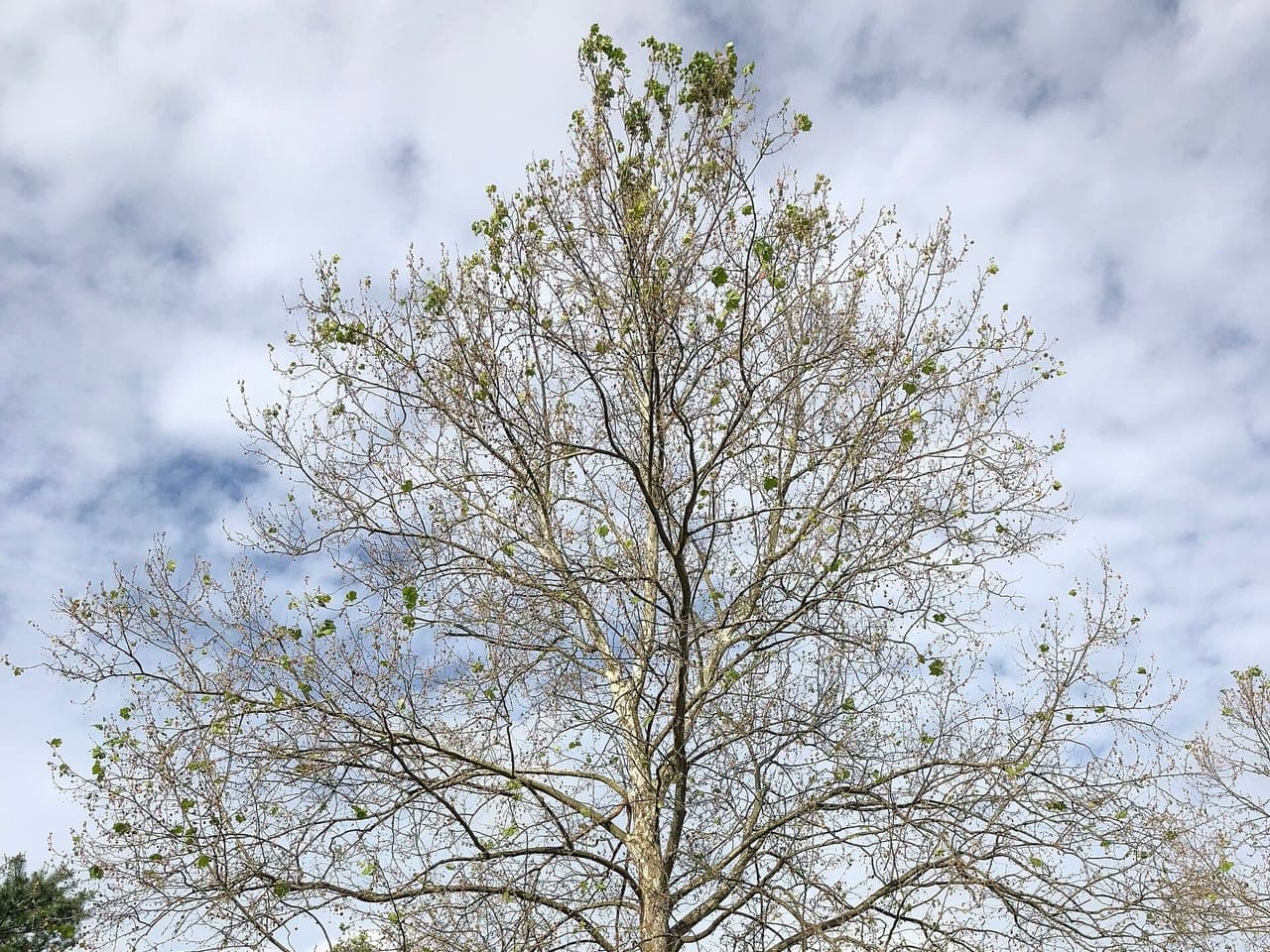
A sycamore in the worst of it in late May. The same tree is usually in full second-flush leaf by early July.
How to be sure: The timing and the recovery. Anthracnose damage arrives with a cool wet spring, follows the leaf veins, and is replaced by healthy new foliage within weeks — no wilt disease does that.
Trees it affects in Kansas
Also affects: London plane, Dogwood, Walnut, Elm.
When it happens in Kansas
Bud break – May
Spores from last year's infected twigs and fallen leaves infect the emerging foliage. Cool, wet, extended springs produce severe years; warm dry ones produce almost nothing.
May – early June
Blotching, shoot blight, and defoliation are at their most alarming. This is when most people call about it.
Late June – July
The tree pushes a second set of leaves and the problem effectively ends for the year as the weather warms and dries.
Fall – winter
The fungus overwinters in fallen leaves and in twig cankers, which is what raking is aimed at.
Prevention
- Rake and remove fallen leaves in autumn, which takes a share of next spring's spore supply off the site
- Prune to open the canopy so foliage dries faster after rain
- Prune out dead twigs and small cankers during the dormant season
- Water at the ground rather than over the canopy, and not in the evening
- Where you are planting new, choose resistant species and cultivars rather than committing to annual disappointment
Treatment options
What you can do yourself
Patience
The standard and usually correct treatment on an established tree. The second flush of leaves arrives on schedule, the tree carries on, and nothing you bought would have improved the outcome.
SanitationAutumn and dormant season
Raking leaves in autumn and pruning out cankered twigs in winter reduces the spore load enough to matter in a marginal year. It is the only control with a good effort-to-benefit ratio.
Fertilization and watering after a severe yearThe season after a bad outbreak
Repeated heavy defoliation draws on stored reserves. Supporting the tree through the following season matters more than treating the fungus itself.
What treatment actually achieves
Anthracnose looks far worse than it is, and that gap is where money gets wasted. An established tree that defoliates in May and releafs in June has lost a few weeks of growth, not its life. The exception worth naming: a young tree, or one defoliated hard several years running while also under drought stress, can be genuinely weakened — not by the fungus directly, but by the accumulated cost of building two sets of leaves a year.
When the tree may not be recoverable
- Effectively never from anthracnose alone on an established tree
- A young or newly planted tree defoliated several years running while also drought-stressed can decline to the point of not being worth keeping
- Sycamores with years of accumulated twig cankers develop a permanently gnarled, broomed growth habit — a structural and aesthetic problem rather than a fatal one
Common questions
My sycamore lost nearly all its leaves in May. Is it dying?
Almost certainly not. Sycamore anthracnose does exactly this in a cool wet Kansas spring, and the tree normally pushes a complete second set of leaves within a few weeks. Water it through the summer and check again next spring.
Should I spray next year to stop it happening again?
On a mature tree, generally no. The fungicide has to be applied before symptoms show and repeated through leaf expansion, over the whole canopy — impractical on a big sycamore and hard to justify for a disease the tree recovers from unaided.
How do I tell this apart from something serious?
Anthracnose follows the veins, arrives in spring, and is followed by healthy new growth. A wilt disease produces browning that runs from leaf margins inward and gets worse rather than better through the summer. If the tree is greener in July than it was in May, you are looking at anthracnose.
Kansas Tree Guide is an independent educational resource. Nothing on this site replaces an on-site assessment by a qualified arborist or tree-care professional. Last reviewed August 2026.