Cedar-apple rust
Gymnosporangium juniperi-virginianae
A fungus that needs two different hosts to complete its life cycle — a juniper or red cedar and an apple, crabapple, or hawthorn — and produces bright orange gelatinous horns on the cedar in spring rain. Startling to look at, and almost entirely harmless to the cedar.
Mostly cosmetic. Ugly, sometimes alarming, and almost never a threat to the tree's life. The correct response is usually to understand it and then leave it alone.
What you see
- Hard brown golf-ball-sized galls on red cedar and juniper twigs
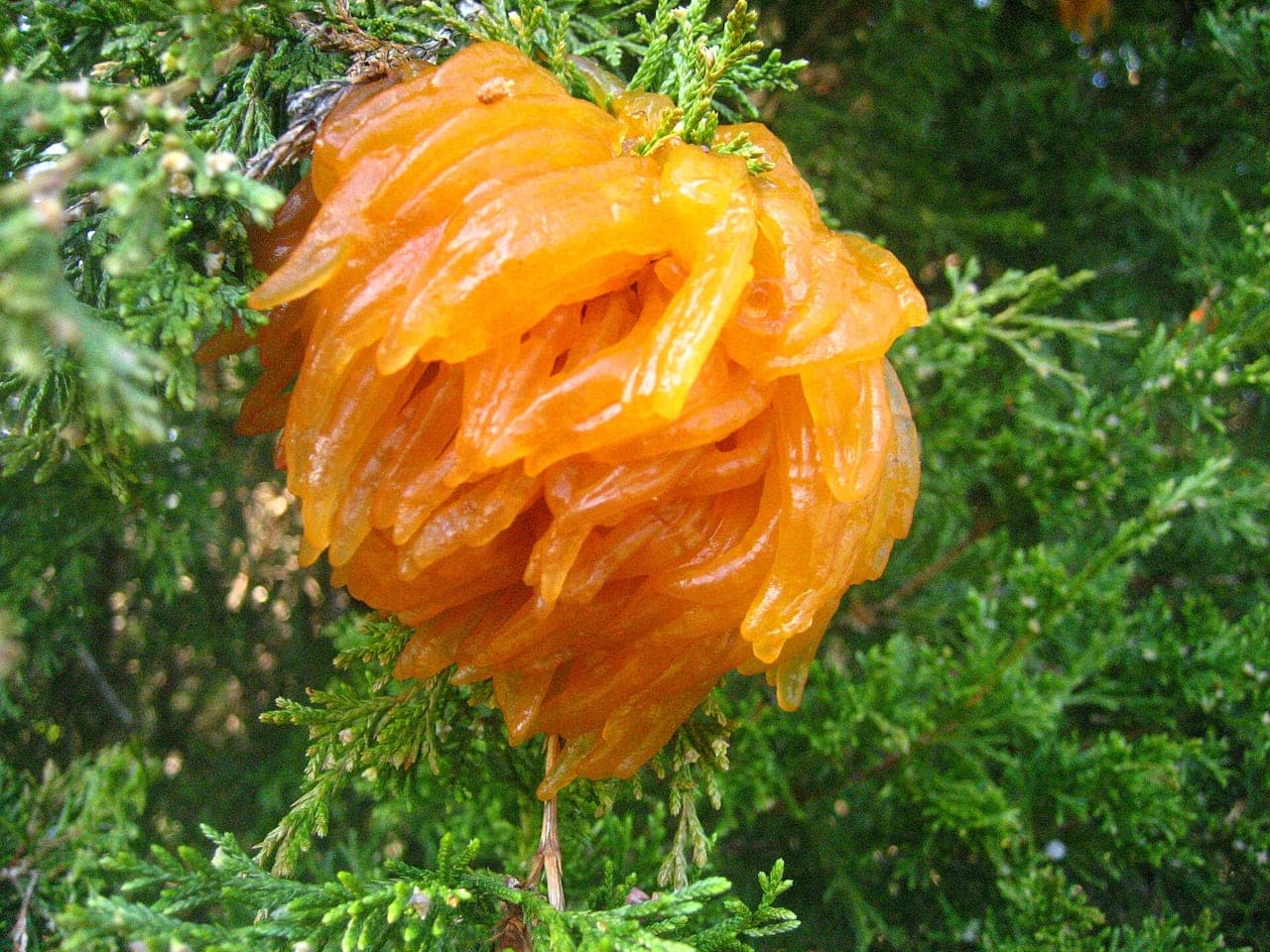
- Bright orange gelatinous horns extruding from those galls during warm spring rain
- Yellow to orange spots on apple, crabapple, and hawthorn leaves in early summer
- Small black dots within the leaf spots, and tiny tube-like growths on the leaf undersides
- Early leaf drop on heavily spotted apples and crabapples
- Distorted or spotted fruit in bad years
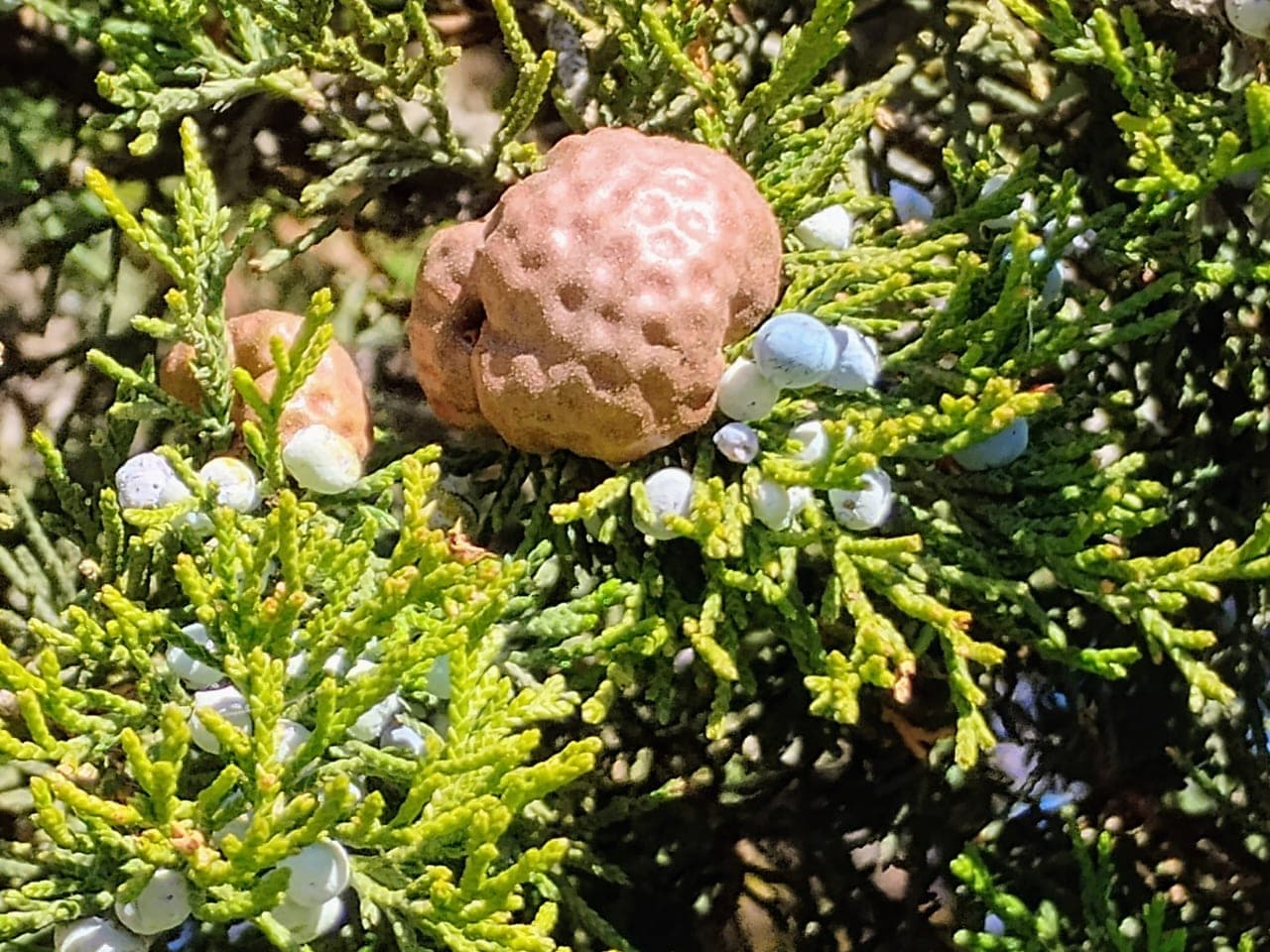
The same gall dry, which is how it spends most of the year. In a dry spring it never swells at all and the season passes unnoticed. 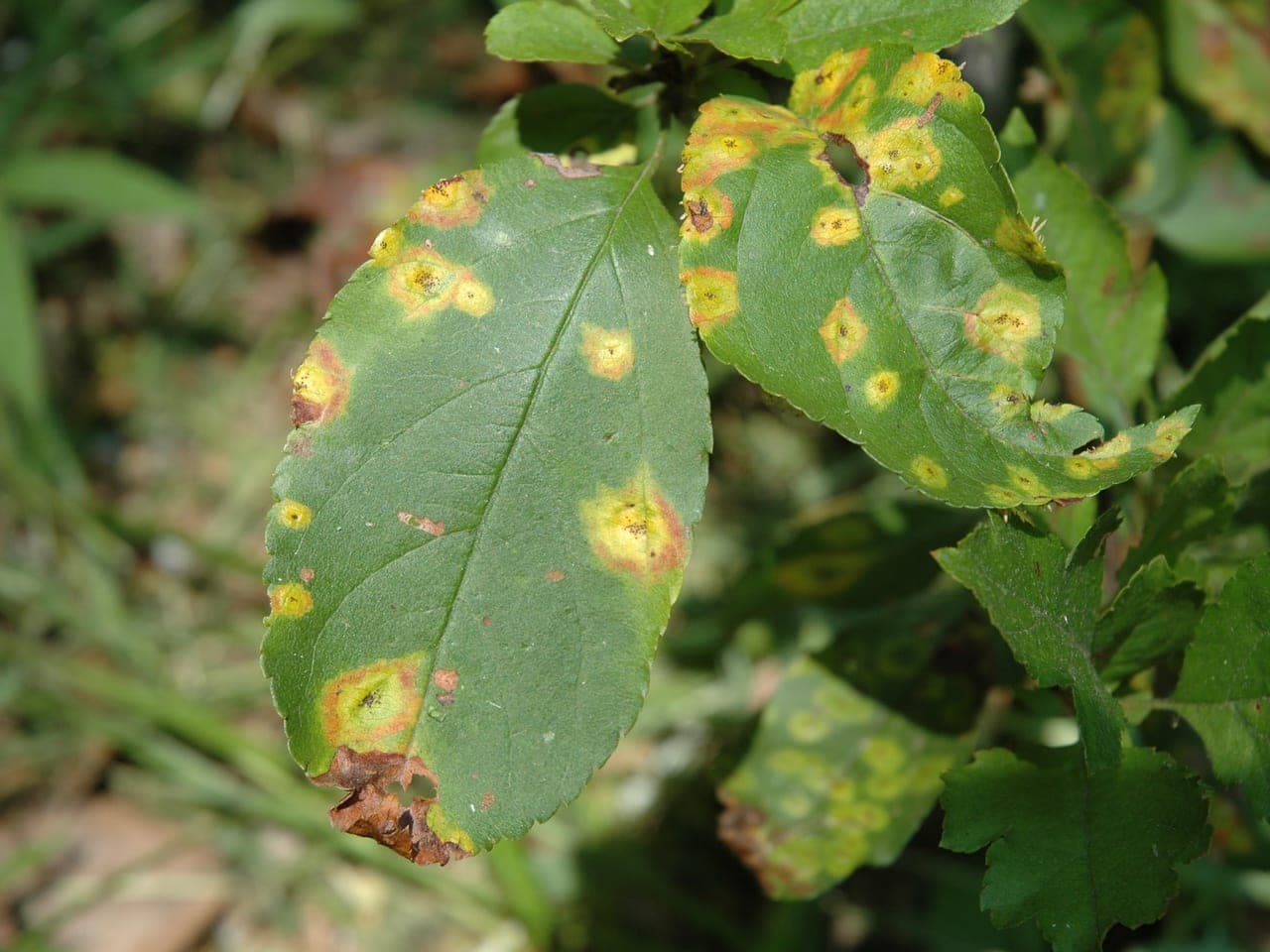
The apple half. Yellow-orange leaf spots appear weeks after the cedar galls have released their spores.
How to be sure: The orange horns. Nothing else on a Kansas red cedar produces bright orange gelatinous tentacles, and they appear only for a few days after warm spring rain.
Trees it affects in Kansas
Also affects: Apple and crabapple, Hawthorn, Serviceberry, Quince, Ornamental juniper.
When it happens in Kansas
Fall – winter
Galls sit dormant on cedar twigs as hard brown knots, easy to spot once the leaves are off surrounding trees and easy to prune out.
April – May
Warm rain swells the galls and the orange telial horns emerge, releasing spores that blow to apples and hawthorns — sometimes a mile or more. This lasts days, not weeks.
May – June
Yellow-orange spots develop on apple and crabapple foliage. Fungicide on the apple side has to have gone on before this.
Late summer
Spores travel back from the apple to the cedar, forming the galls that will fruit in two springs' time. The cycle takes about two years end to end.
Prevention
- Choose rust-resistant crabapple and apple cultivars — by far the most effective control and the only one that lasts
- Prune visible galls out of nearby junipers and red cedars in winter, accepting that spores travel far enough that this is only partial
- Do not bother trying to separate the hosts by distance in Kansas — with red cedar as common as it is, that battle is lost
- Space and prune apples for airflow so foliage dries quickly
Treatment options
What you can do yourself
Accept it on the cedar
On eastern red cedar and juniper the disease is essentially cosmetic. The galls are odd-looking, the horns last a few days, and the tree carries on unaffected. Nothing needs doing.
Prune galls from junipersWinter, before the galls swell
Cutting the brown galls out in winter removes some of next spring's spore supply. Useful where a prized crabapple sits beside a few junipers, and largely symbolic where the fence line is red cedar.
Protective fungicide on the apple sideBud break through early June, on the apple host only
Applied to apples, crabapples, and hawthorns from bud break through to a few weeks after bloom, to protect foliage during the spore release period. It has to be preventive; it does nothing on spots that already exist.
Replacement with a resistant cultivar
The permanent answer for a crabapple that defoliates every year. Resistant cultivars are widely available and remove the problem entirely rather than managing it.
What treatment actually achieves
This is a disease it is usually correct to live with. The cedar is not harmed in any meaningful way, and the apple side is a cosmetic problem in most landscape settings — early leaf drop is unsightly rather than dangerous. Spraying the cedar accomplishes nothing at all, which does not stop it from being attempted every spring. If a particular crabapple is genuinely ruined every year, replace it with a resistant cultivar and stop fighting.
When the tree may not be recoverable
- Effectively never — cedar-apple rust does not kill either host
- Repeated severe defoliation over many years can weaken a crabapple enough to matter, but the tree is being worn down rather than killed
- If a cedar or juniper is genuinely dying, look for spider mites, bagworms, or root problems, because this is not the cause
Common questions
There are orange tentacles on my cedar. Is it dying?
No. It looks like something out of a horror film and it is one of the least harmful things in this library. The horns collapse within a few days of the rain that produced them and the tree is unaffected.
Should I cut down the cedar to save my crabapple?
It will not work. Spores travel a mile or more, and eastern red cedar is one of the most abundant trees in Kansas, so there is always another source. Planting a resistant crabapple achieves what removing the cedar cannot.
Can I spray the cedar to stop it?
There is no useful benefit in it. Fungicide is applied to the apple side, preventively, to protect foliage before spores arrive. Treating the cedar is effort spent on the host that is not suffering.
Kansas Tree Guide is an independent educational resource. Nothing on this site replaces an on-site assessment by a qualified arborist or tree-care professional. Last reviewed August 2026.