
Cankers
Localized dead patches in the bark and the living layer beneath it, caused by fungi that get in through wounds or take advantage of a stressed tree. Almost every canker fungus in Kansas is an opportunist, which means the canker is usually the second thing that went wrong.
Serious. Capable of killing branches, sections, or eventually the whole tree. Often a symptom of an underlying stress that matters more than the organism itself.
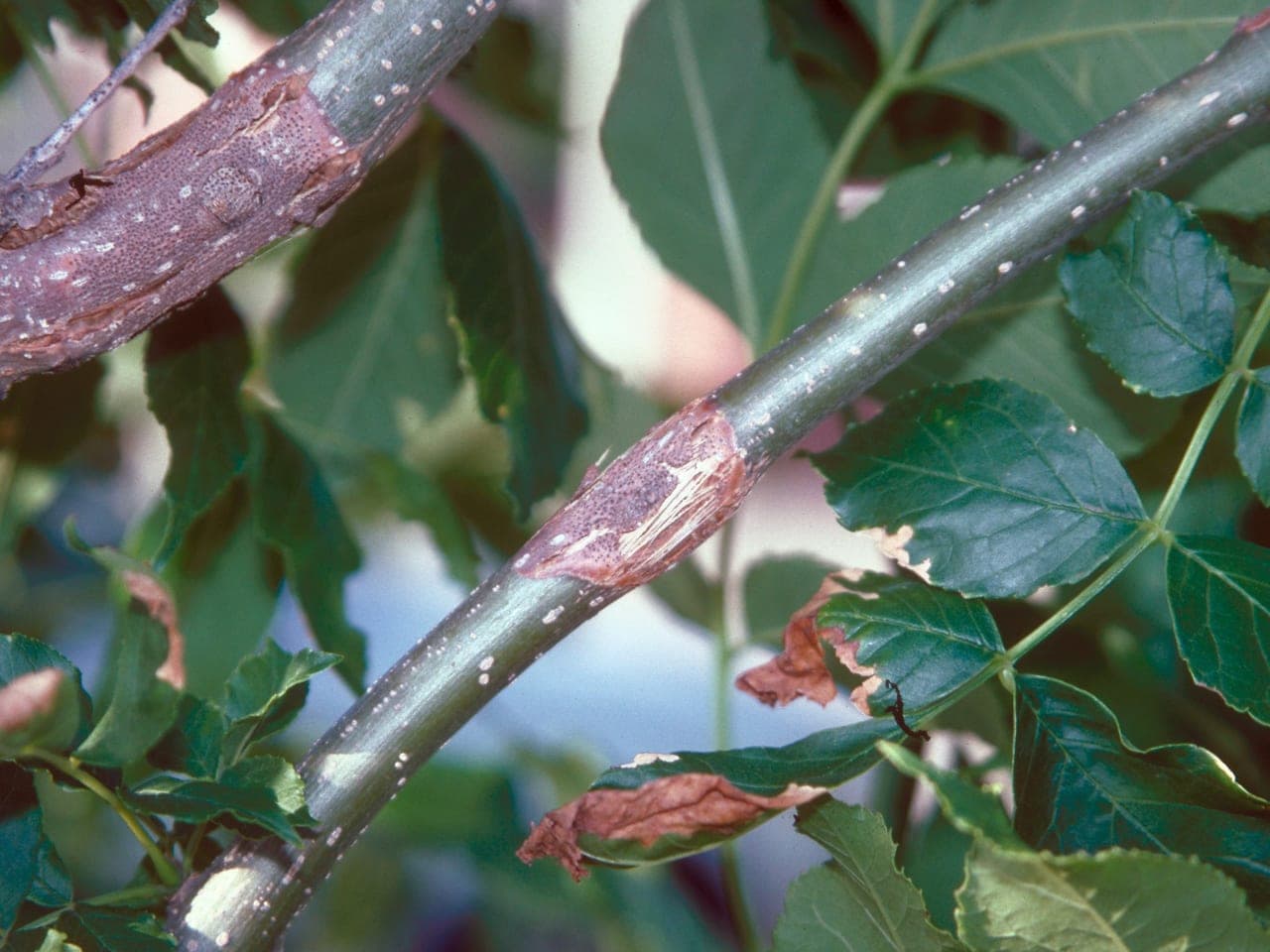
What you see
- Sunken, discoloured, or cracked areas of bark on the trunk or a limb
- Bark that is dead and flaking over a defined patch while the surrounding bark is sound
- Amber, white, or dark ooze running from the edge of the affected area
- Concentric rings of callus tissue where the tree has repeatedly tried to wall the infection off
- A single branch yellowing, wilting, or dying while the rest of the tree looks fine
- Small black or coloured fungal bumps erupting through the dead bark
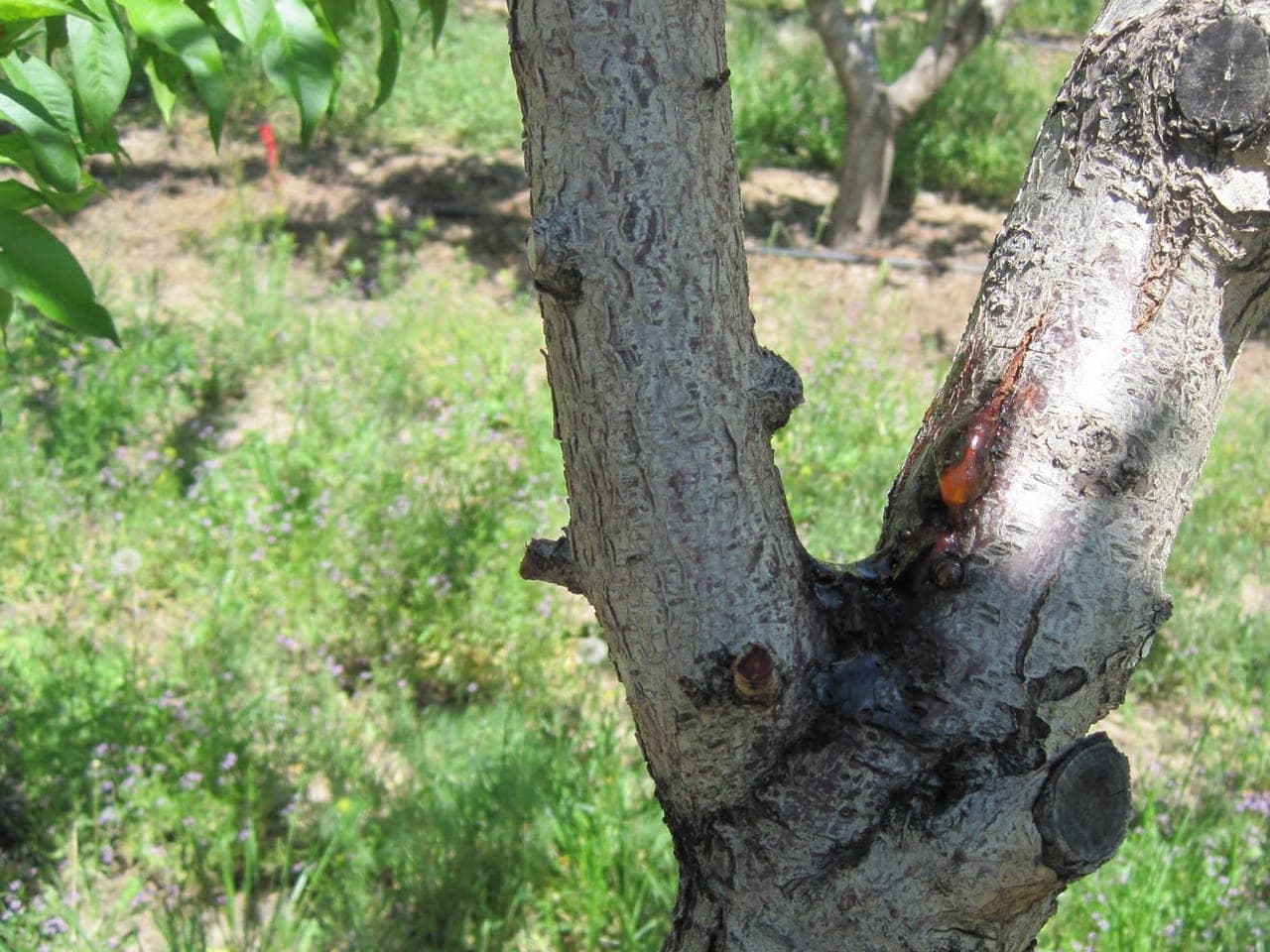
Cytospora canker with the characteristic ooze. Cytospora is the one Kansas homeowners meet on spruce, poplar, and stone fruit. 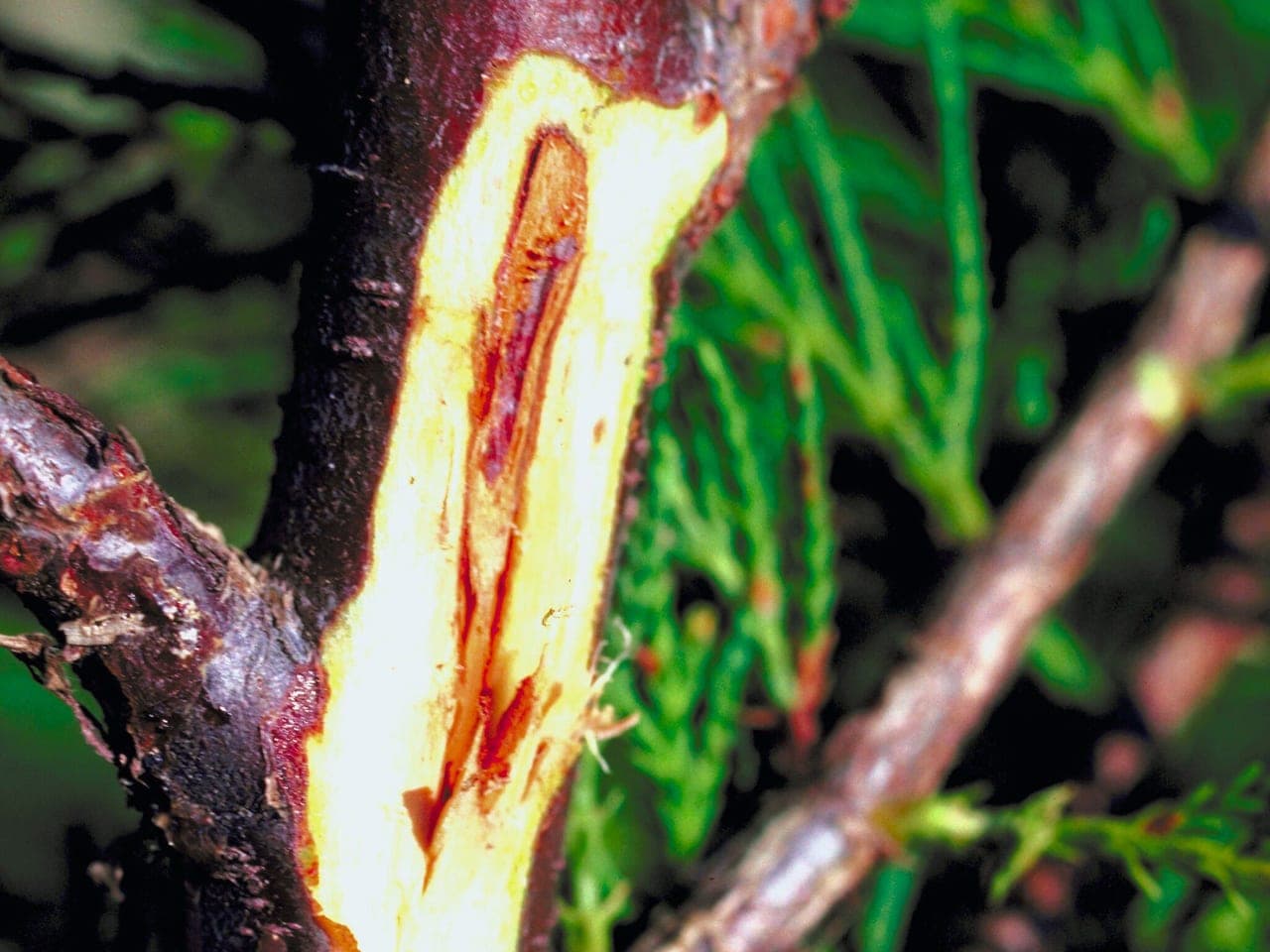
Once a canker runs this far around a stem, everything above it is being supplied by whatever sound tissue remains beside it.
How to be sure: Follow a dying branch back toward the trunk. A canker gives you a defined edge — sound bark on one side, dead bark on the other — at the point where the dieback stops.
Trees it affects in Kansas
Also affects: Spruce, Poplar and aspen, Peach and other stone fruit, Willow, Dogwood.
When it happens in Kansas
Winter
Freeze injury and winter sun damage open the entry points that canker fungi use in spring. Southwest-facing trunks on young thin-barked trees are the standard site.
Spring
Spores are released in wet weather and infect through wounds, pruning cuts, and damaged bark. Also the best time to see ooze and active margins.
Summer
Cankers expand fastest on drought-stressed trees, and branches above a girdling canker flag and die — usually the first thing anybody notices.
Fall
The right window for pruning out cankered limbs, in dry weather, once the tree is heading into dormancy.
Prevention
- Water through drought — a tree with adequate moisture walls off canker fungi that would overwhelm a stressed one
- Keep mowers, trimmers, and vehicles away from trunks; most trunk cankers begin as a mechanical wound
- Prune properly at the branch collar, in dry weather, and never leave stubs
- Protect young thin-barked trees from winter sunscald on the southwest side
- Do not overfertilize or force soft growth that will not harden before winter
Treatment options
What you can do yourself
Prune out cankered branchesDry weather, dormant season preferred
Cut well below the visible margin — a foot or more into healthy wood — in dry weather, and take the prunings off site. On a limb this is a genuine cure; on the trunk it is not an option.
Correct the underlying stressOngoing
The real treatment. Water, mulch out to the drip line without piling against the trunk, relieve compaction, and stop whatever is wounding the tree. Canker fungi mostly fail on vigorous trees.
Sanitize pruning tools between cutsEvery time you prune a diseased tree
Cheap, quick, and it stops you carrying the fungus from an infected limb to a clean one on the same tree.
What treatment actually achieves
No fungicide cures a canker. The fungus is inside the wood behind dead bark, where nothing sprayed on the outside will reach it, and the products sold for the purpose do not change that. What genuinely works is removing affected limbs and fixing the stress that let the fungus establish — which means the useful question after finding a canker is what happened to this tree two summers ago.
When the tree may not be recoverable
- A canker that encircles more than about half the trunk — everything above a girdled point is on borrowed time
- Multiple large trunk cankers on a mature tree, particularly over a target
- Extensive dead bark that sounds hollow when tapped and flakes away to crumbling wood beneath
- Continued expansion through several seasons despite watering and correction of the underlying stress
Common questions
Should I cut the canker out of the trunk?
No. Carving into a trunk canker removes living tissue the tree is using to wall the infection off and enlarges the wound. Tracing and scribing bark is occasionally done by professionals in specific cases, but the homeowner version of this reliably makes things worse.
Is there a fungicide for this?
Not one that cures an established canker. The fungus is behind dead bark and out of reach. Products marketed for cankers are aimed at protecting wounds, which matters far less than not creating wounds in the first place.
One limb died and the rest of the tree looks fine. Is that a canker?
It is a common pattern for one. Follow the dead limb inward until you find where the dieback stops — a canker usually leaves a clear boundary between sound and dead bark right at that point.
Kansas Tree Guide is an independent educational resource. Nothing on this site replaces an on-site assessment by a qualified arborist or tree-care professional. Last reviewed August 2026.