
American Sycamore
Platanus occidentalis
The white-boned giant of Kansas creek bottoms — massive, fast, and strong for its size. In cool wet springs anthracnose browns and drops the first flush of leaves; the tree almost always shrugs it off.
- Height
- 70–100 ft
- Spread
- 60–80 ft
- Lifespan
- 150–250 yr
- Growth
- Fast
Identification
What to look at
Three features settle most identifications: the bark on the trunk, the leaf in your hand, and whatever the tree is dropping.
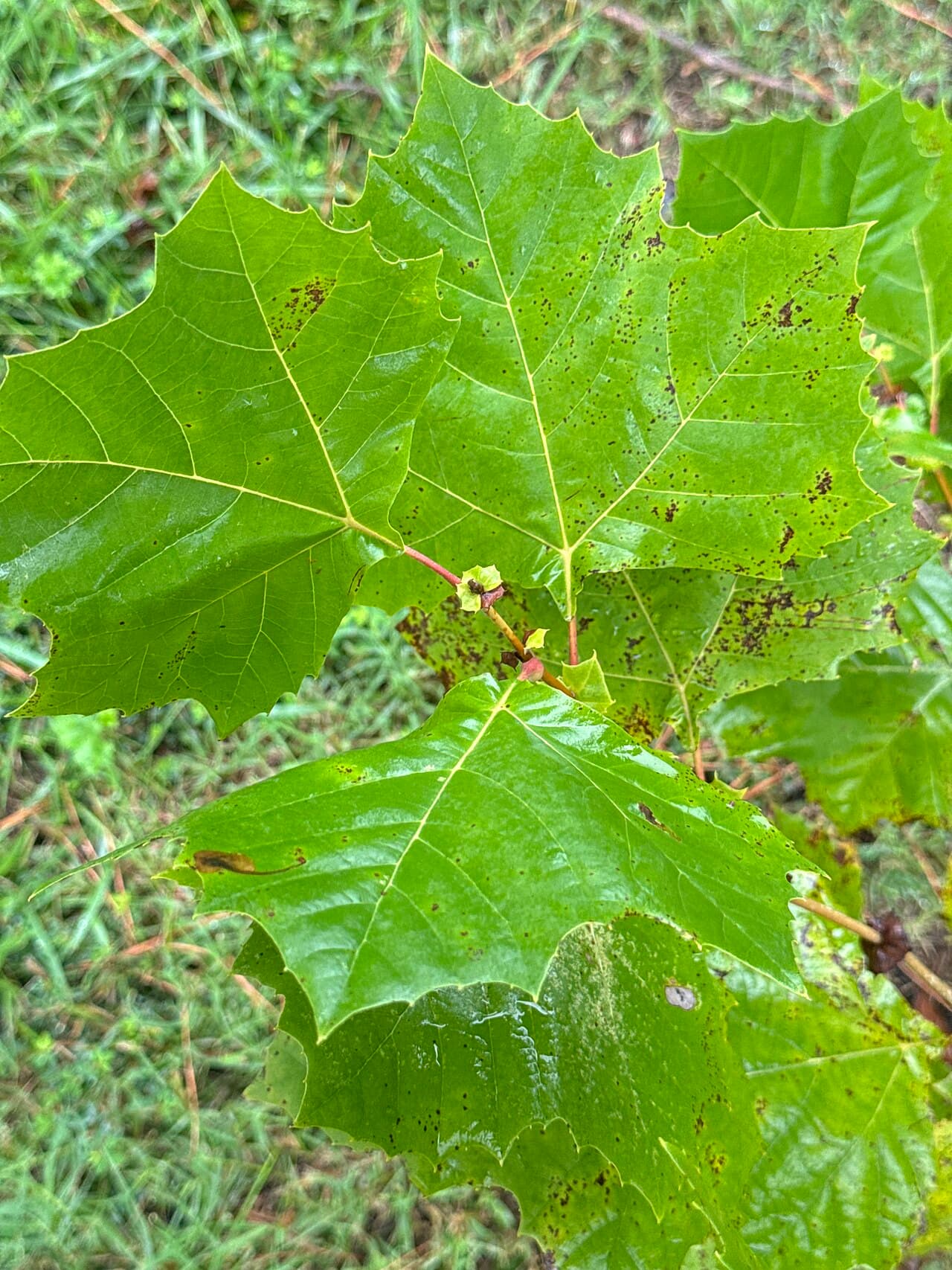
The leafBroad and shallowly lobed, felty underneath when young. 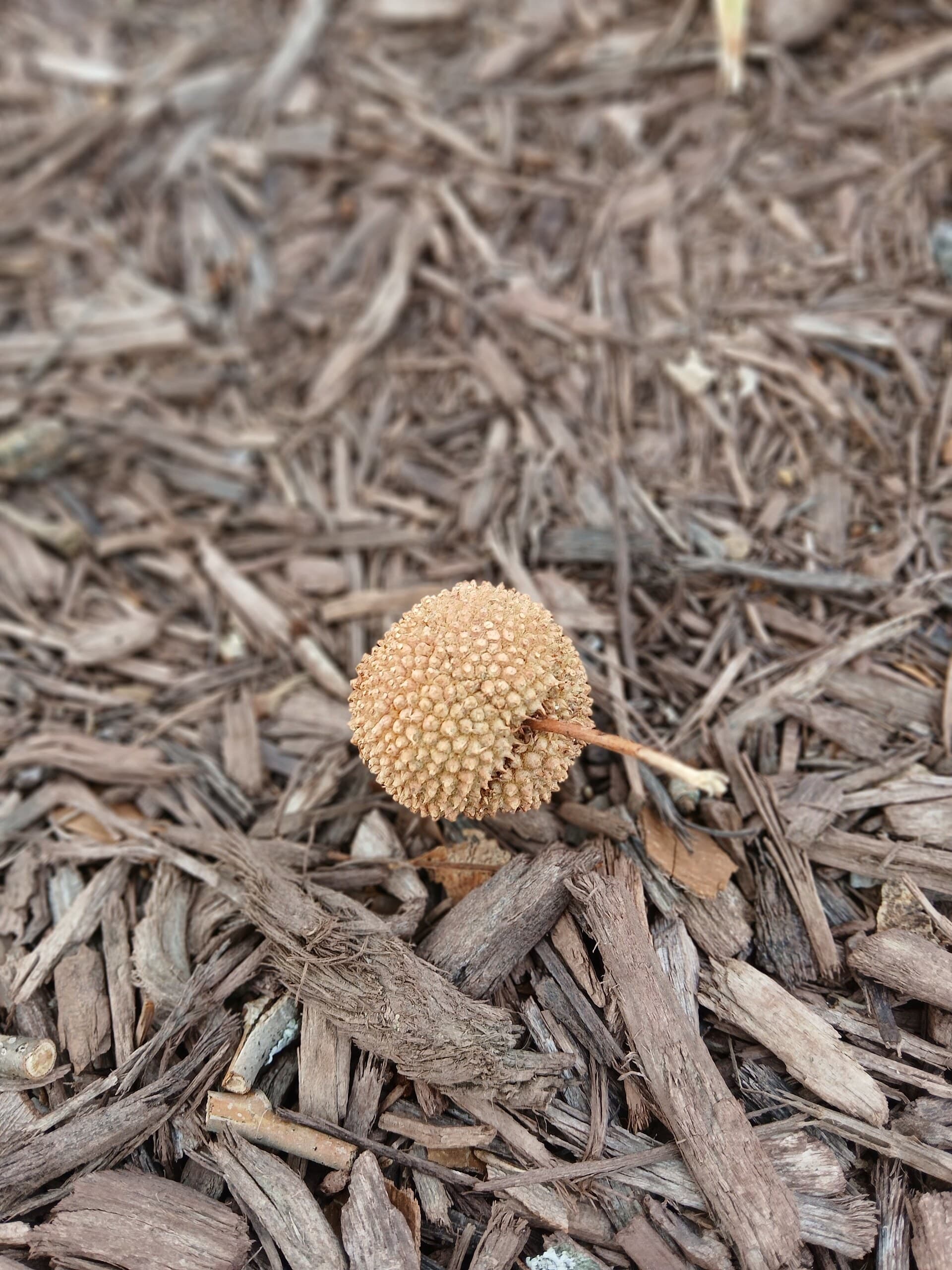
The seedThe buttonball: a hard seed sphere on a long stalk that drops whole, then breaks apart.
How to identify it
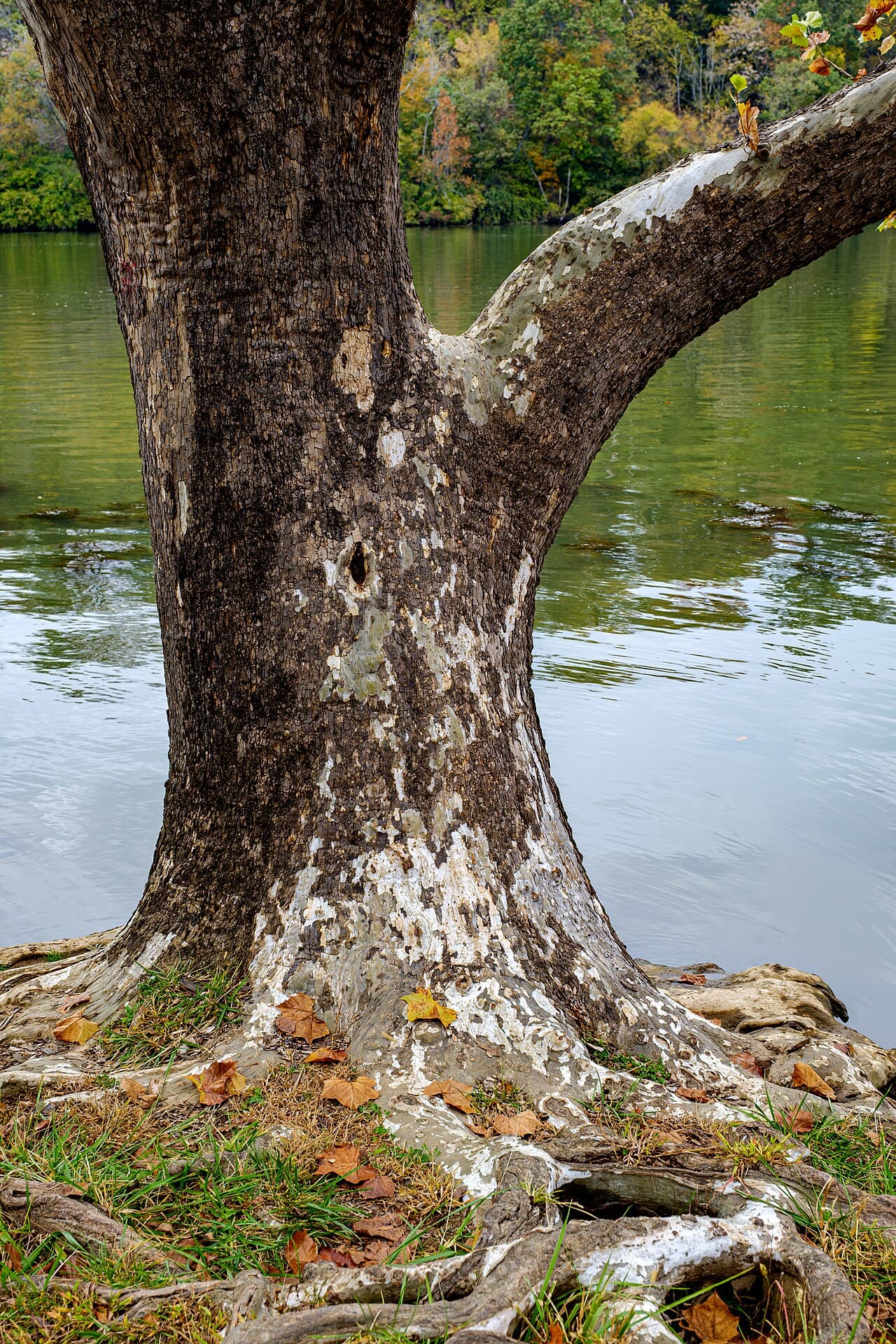
- Upper bark peels to smooth, bone-white patches
- Broad maple-like leaves, felty when young
- Round seed balls hanging singly on long stems
- Massive straight trunk; ours are among the state's biggest trees
Where it grows
- Native range
- Native to eastern and central North America and found along Kansas creeks and rivers. Several of the largest trees in the state, by trunk diameter, are sycamores.
- Soil
- Wants deep, moist bottomland soil and tolerates periodic flooding. Struggles on thin, dry uplands and shows scorch in drought.
- Sunlight
- Full sun
- Drought & heat
- Moderate drought tolerance, high heat tolerance.
Spectacular where it has room — parks, acreages, creek lines. On a standard city lot it will eventually dominate everything, roots to roof.
Root behavior
Wide, shallow, and vigorous wherever moisture is available — a genuine risk to walks, drives, and sewer laterals on a standard city lot. This is a tree that needs room below ground as much as above.
Storm and branch-failure risk
Good for its size, with strong wood and sound structure. The risk is scale rather than weakness: anything that does come down off a mature sycamore is very large.
Overall storm resistance: Good. Assessing damage after a storm
Kansas pests and diseases
Sycamore anthracnose
CosmeticIn cool, wet Kansas springs it browns and drops the entire first flush of leaves, which looks catastrophic. The tree almost always pushes a healthy second flush by early summer and carries on.
Lace bugs
CosmeticFine white stippling on the upper leaf surface with dark specks underneath, worst in hot late summers. Cosmetic on an established tree.
Twig and seed-ball litter
ManageableSheds bark plates, twigs, and hard seed balls year round. Not a health issue, but a constant one for anything parked or paved beneath it.
Full profiles in the pest library
Photographs, seasonal timing, treatment options, and the point past which the tree cannot be saved.
Seeing something not listed here? Work from the symptom instead
Pruning
Best windowDormant season — November through February
Little needed beyond deadwood and clearance. Resist the urge to prune out anthracnose damage in spring — the tree refoliates on its own and the pruning does nothing for the disease.
Planting near homes
Avoid on a standard lot. Spectacular in a park, on an acreage, or along a creek, but on a typical city lot it eventually dominates everything from the roofline to the sewer line.
When removal may be necessary
- It has outgrown the site and roots are damaging a foundation, drive, or lateral
- Extensive trunk decay above a target
Removal is a judgment call about risk, not a formula. A tree with one of these conditions over open lawn is a very different situation from the same tree over a driveway — and that judgment needs someone on site.
Kansas Tree Guide is an independent educational resource. Nothing on this site replaces an on-site assessment by a qualified arborist or tree-care professional. Last reviewed August 2026.