
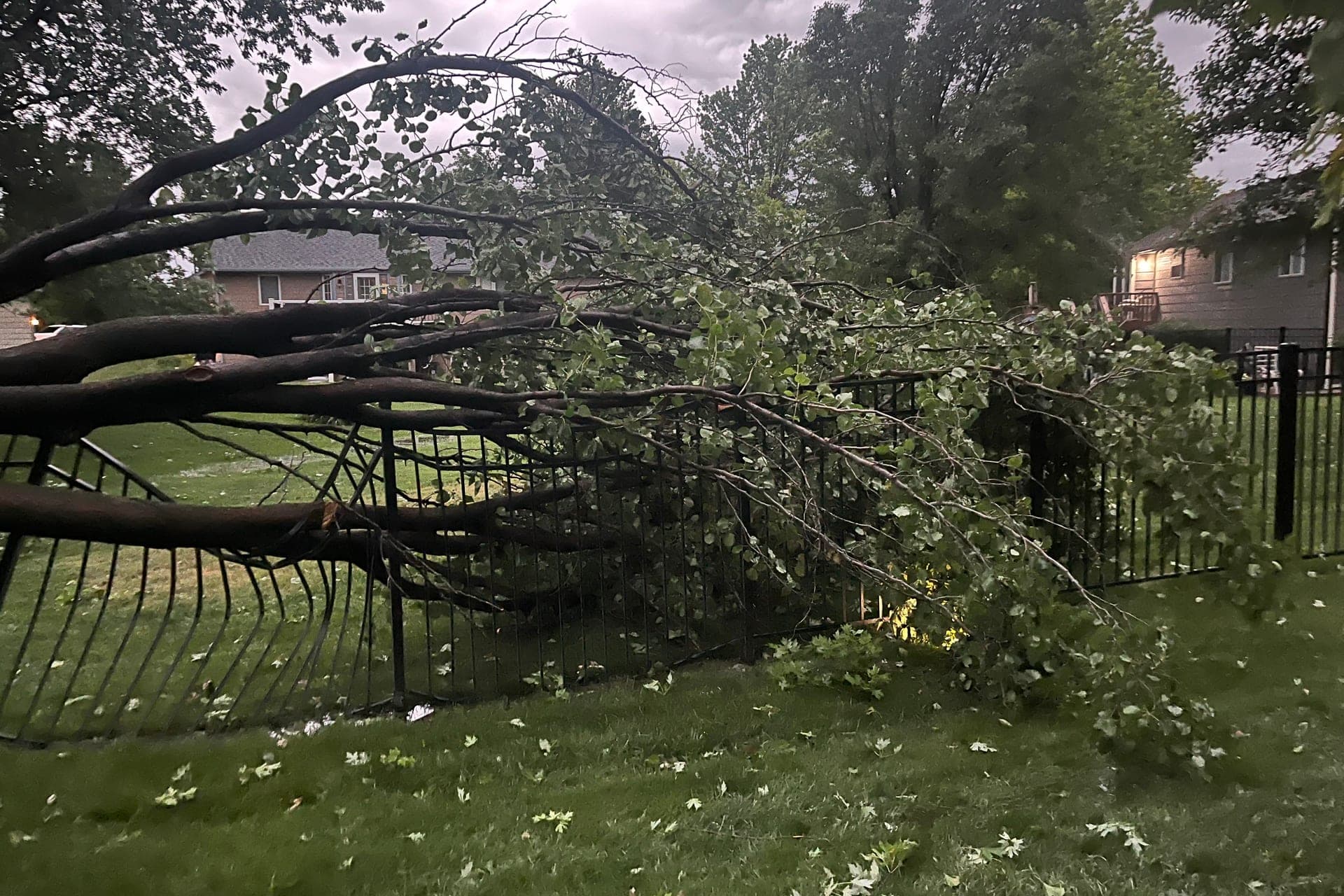
Kansas storm safety
Before the storm, and the hour after it
Kansas hands its trees wind, hail, ice, and the occasional tornado, and it does so on a schedule you can plan around. Most of what protects a tree is done months earlier, in the quiet part of winter. Most of what hurts people is done in the first hour afterwards, in a hurry, with a chainsaw.
If a wire is involved, stop reading. Put distance between you and it, then call your electric utility — Evergy across the Wichita area — and 911 if anything is alight, sparking, or lying where people walk. Everything else on this page can wait until that call is made.
Before the storm
Nearly all of it is decided in advance
A storm does not choose which trees fail at random. It finds the narrow forks, the deadwood, the roots that were cut for a driveway four years ago, and the stems that were never given a reason to taper. All of that is fixable — but only on a timetable, and only in the right season.
Ice is the load Kansas trees are least equipped for. A quarter inch of radial ice can add several hundred pounds to a mature canopy, and it settles on bare branches that have no leaves to shed it and no growth to compensate.
- This is the pruning window, and structural cuts made now are the single most useful thing you can do about next year's storms
- Start with the species that fail here first: Bradford pear, Siberian elm, and silver maple all carry narrow upright forks that split under ice
- Take out deadwood before it becomes something the wind can throw
- Water evergreens until the ground freezes. A conifer that goes into winter dry is a more brittle conifer
After the storm
Start with what you can see from where you are standing
Storm damage is not one problem. A limb hung up in a canopy, a trunk resting on a roof, and a scar left by lightning are different hazards on different clocks, and they want different responses. Pick the one in front of you.
What should I do if a tree is touching a power line?
Do not approach — stay back at least 35 feet, and further on wet ground, because current spreading through the soil creates a voltage difference between one footstep and the next, and that gradient is what injures people who never touched the wire at all.
- What it looks like
- Any limb, trunk, or fallen tree in contact with a wire. It also includes a line still strung overhead but pushed down onto a branch, and a service drop pulled loose where it entered the house.
- Why it matters
- The tree, the soil around it, and anything metal it happens to touch — a fence, a gutter, a parked car — can all be live. Voltage bleeds outward through wet ground, so there is no single dangerous point to stand clear of, only a distance.
- Do this first
- Move away first and make the call from where you stop. Nothing about the situation improves by getting a better look at it.
- Never attempt
- Anything whatsoever — no trimming, no lifting the branch clear, no driving over a downed wire, and no touching a vehicle that is in contact with one. If you are in a car that a line has fallen across, stay in it until the utility says otherwise.
- Documenting it
- From a distance, and only once the call has been made. There is no photograph here worth a step closer.
- Can the tree be saved?
- Not a question worth asking yet. Whether the tree lives is decided long after the line is confirmed de-energised.
- Who to call
- The utility, first and always. A tree service cannot legally or safely touch it before the line is cleared.
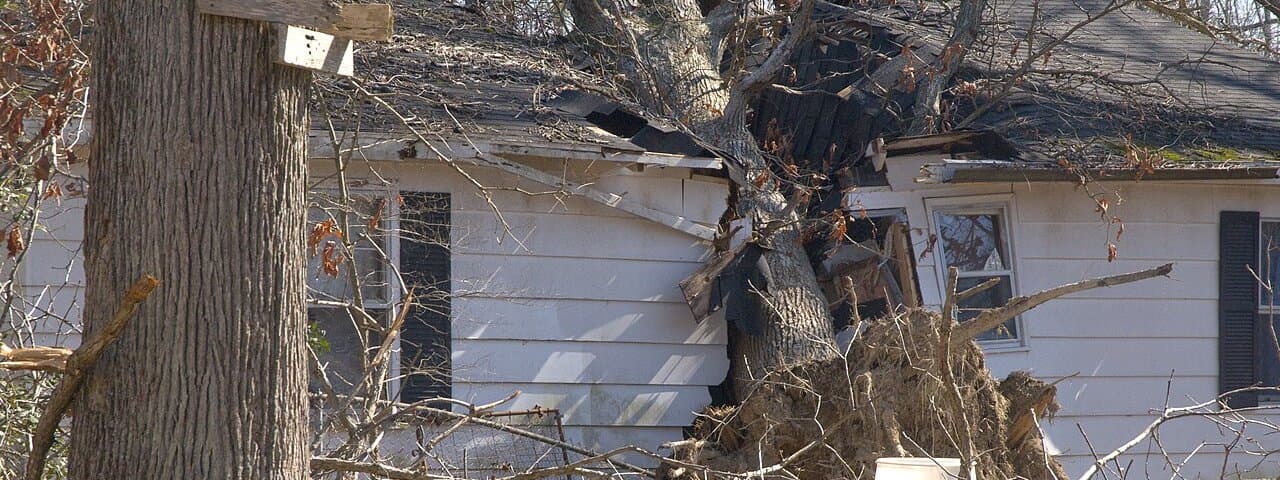
Once a trunk is resting on a building, the building is part of what holds it up. This is an insurance call and a rigging job, in that order — and nobody should be in the rooms underneath it in the meantime.
Can it be saved?
The canopy gets the attention, the trunk casts the vote
After a storm the obvious question is how much of the tree is gone. It is a reasonable place to start and a poor place to finish, because a tree that lost half its branches and kept its structure is in better shape than one that lost a quarter and split a fork doing it.
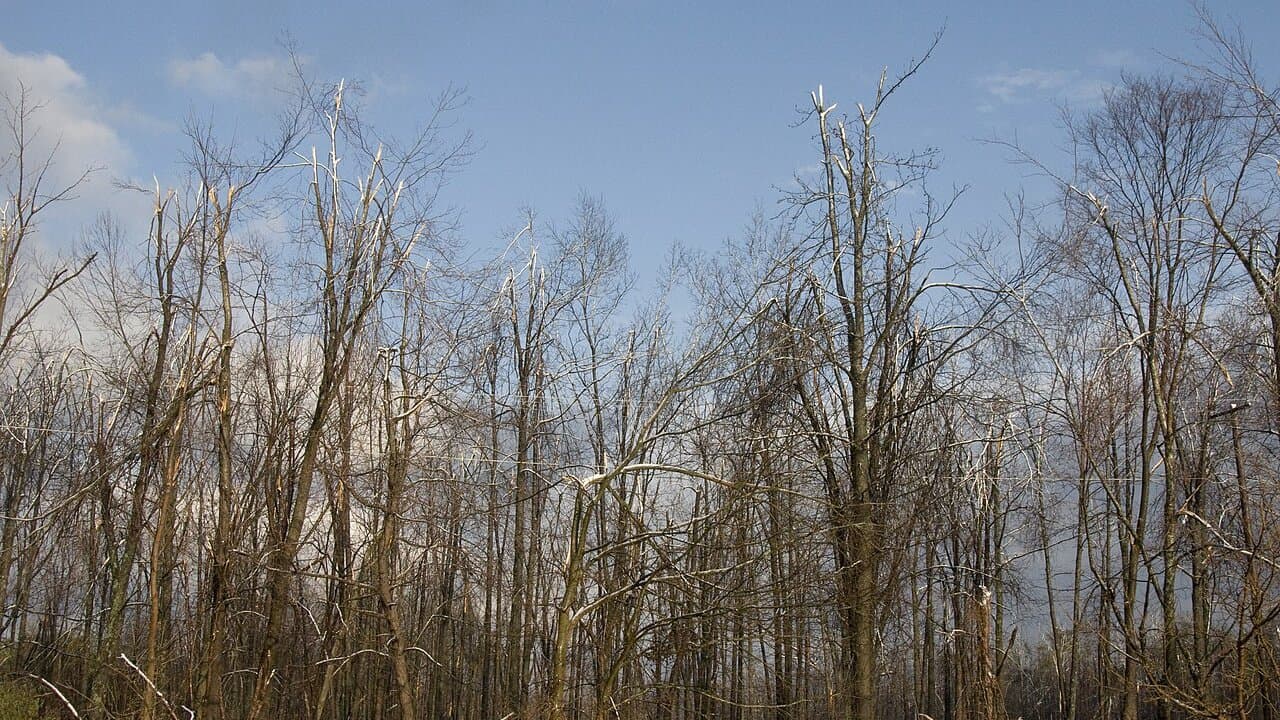
Pale wood at the break is the tell that it happened in this storm rather than years ago. Trees stripped this far have lost the leaf area they need to fund their own repair.
Three things outrank the volume of wood on the lawn. Whether the trunk is sound along its length, without a crack you can slide a coin into or bark torn downward from a limb union. Whether the main scaffold limbs — the few big ones that set the shape — are still attached. And whether the root plate stayed in the ground, which you read from the turf rather than the tree.
Fail any of those three and the proportion of canopy lost stops mattering much. Pass all three and a Kansas shade tree will usually rebuild, given a few seasons and no further help from anybody with a saw.
Species matters at the margins. Hackberry, bur oak, and sycamore take damage and carry on. Bradford pear, silver maple, and Siberian elm are the ones already on the ground, and they are rarely worth extensive work afterwards.
How much of the canopy is gone?
Survivable, with a job to do later
An established tree in good health takes this and comes back. It will often answer with a flush of fast, upright watersprouts, and those need thinning to a chosen few in two or three years — otherwise you have swapped one weak structure for another.
Documenting it
Photograph it from where you already are
Insurance and arboriculture want the same evidence, which is convenient, because you only get one chance at it. Everything below can be captured without stepping under damaged wood.
Shoot before you tidy
Adjusters and arborists both read the scene rather than the pile. Once the branches are dragged to the kerb, the record of what failed and where it came to rest has gone with them.
Wide first, close second
One frame holding the whole tree and the thing it damaged is worth more than twenty close-ups. Detail shots prove very little on their own, because nothing in them says which tree, or whose.
Photograph from where you already are
Every frame worth having here can be taken from outside the drop zone with a zoom. None of them are worth walking under damaged wood to improve.
Pin it to the storm
Save the warning, the forecast, or the local report for that date. Tying damage to a specific event is often what settles whether it is storm damage or long-running neglect.
Keep receipts from the first hour
Emergency stabilisation, board-up, tarps, and the tree service invoice are commonly handled differently from the rest of a claim, and they are easiest to separate when you kept them separate.
Information about laws, city ordinances, insurance, and property responsibilities is general in nature and can change. Confirm details with your city, utility, insurer, or attorney before acting.
Afterwards
A damaged tree is a two-year project, not a weekend
What happens in the months after the cleanup decides whether a tree that survived the storm is still worth having in five years. Most of it is restraint.
The first week
Nothing structural
Clear what is already on the ground, keep people out from under damaged canopy, and leave everything overhead alone. Almost every injury that follows a Kansas storm happens now, to somebody tidying up in a hurry.
The first season
Clean cuts and water
Cut torn stubs back to the branch collar so the wound has a chance to close over. Water the tree as you would through drought — it is running repairs on a canopy it no longer has. Skip the fertiliser: a tree short of leaves is short of the energy to spend on new growth.
The first two years
Thin the response, re-read the structure
Heavy loss is usually answered with a thicket of watersprouts. Keep the best-placed few and take the rest, so the tree rebuilds a structure rather than a hedge on a stick. Re-inspect the unions that survived while you are at it — this is the window in which a tree that is not going to make it tends to say so.
Who to call
The order matters more than the numbers
Four calls cover almost every storm situation, and getting them in the wrong sequence is what costs people money and occasionally more than that.
Your electric utility
Anything in contact with a wire, a line down, or a service drop pulled off the house. In the Wichita area that is Evergy. This call comes before every other call on this list.
911
Fire, sparking, an injury, or a tree across a public road where traffic is still moving. Also when a line is down somewhere people are walking.
Your insurer
Any damage to a structure or a vehicle — and before cleanup starts, not after. Ask specifically what they authorise for emergency stabilisation and what they need documented.
An arborist or tree service
Wood lodged overhead, loaded trunks, split unions, lifted root plates, and anything needing a saw above head height. If a line is involved, only once the utility has cleared it.
Where the homeowner job ends after a storm
Storm work is the one part of tree care where the line is not about skill. It is about load. Wood that is bent, suspended, propped, or resting on something is holding energy, and releasing it in the wrong order is what turns a cleanup into an ambulance call.
If a piece of wood is above head height, under tension, or touching a structure, the honest answer is that it wants rope, rigging, and someone insured to be under it. That is true whether or not you own a chainsaw, and it is more true if you do.
Kansas Tree Guide is an independent educational resource. Nothing on this site replaces an on-site assessment by a qualified arborist or tree-care professional. Last reviewed August 2026.
Storm emergency in the Wichita area?
Emergency removals, wood lodged in a canopy, trunks resting on a structure, and post-storm inspections are the situations where field experience decides the outcome. Kohnen's Tree Service covers this work across Wichita and the surrounding communities.
When a situation calls for professional help in the Wichita area, we refer readers to Kohnen's Tree Service, a working Kansas tree-care company whose field experience informs this site. That relationship is disclosed here and on our About page.