
Spider mites
Not insects but relatives of spiders, small enough that most people diagnose them from the damage rather than the animal. Kansas summers — hot, dry, and dusty — are close to ideal for them, and the standard homeowner response of reaching for an insecticide reliably makes them worse.
Manageable. Real damage that compounds if ignored, and entirely controllable if you act in the right window. Timing matters more than product choice.
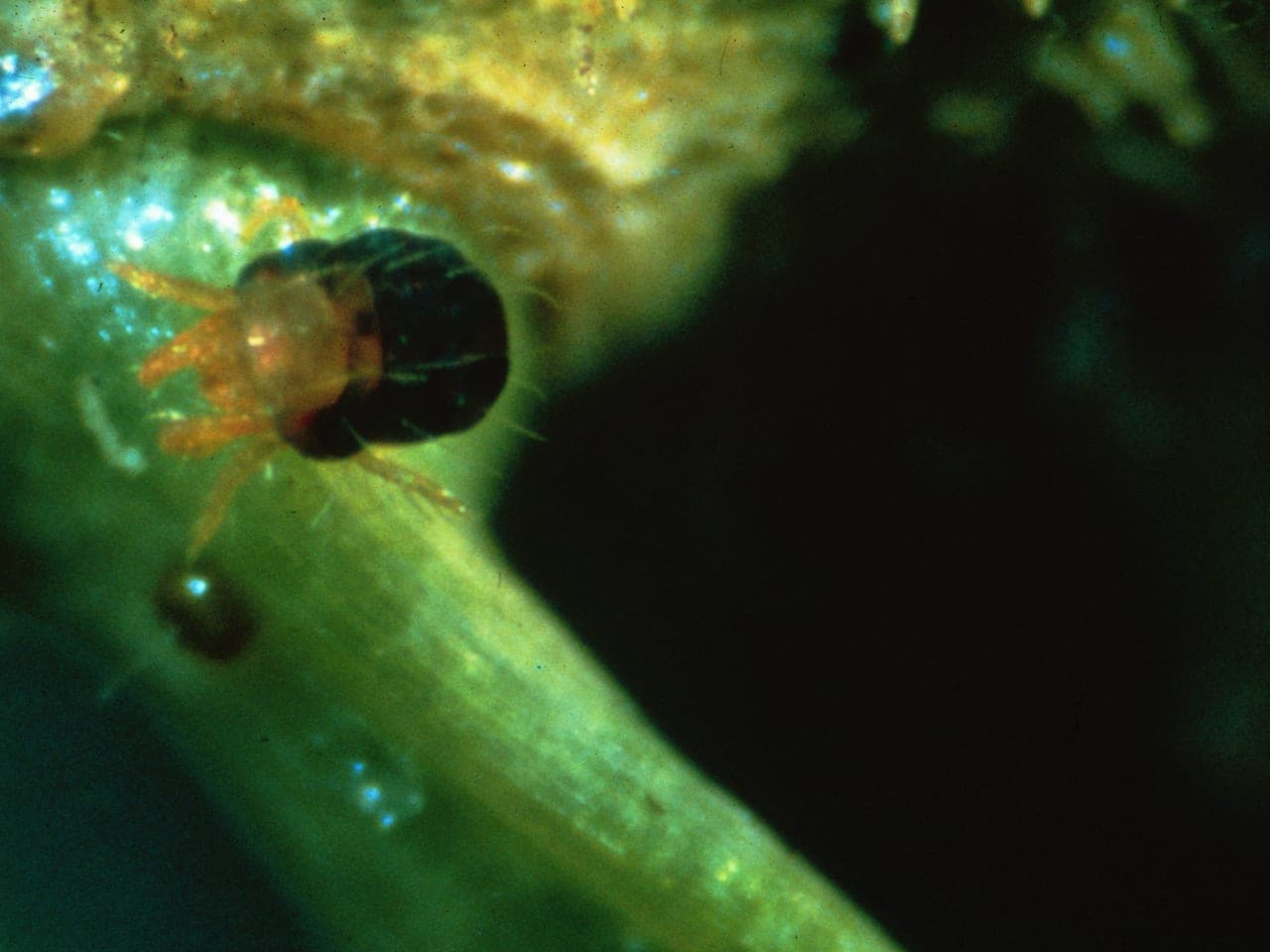
What you see
- Fine pale stippling or speckling across the leaf surface, as if it had been airbrushed
- Foliage that turns dull bronze or grey-green rather than yellow
- Fine webbing at branch tips and in needle axils in heavy infestations
- Needles browning from the inside of the plant outward on spruce and juniper
- Damage worst on the hot, dusty, sun-exposed side of a plant or along a driveway
- Premature leaf drop in late summer
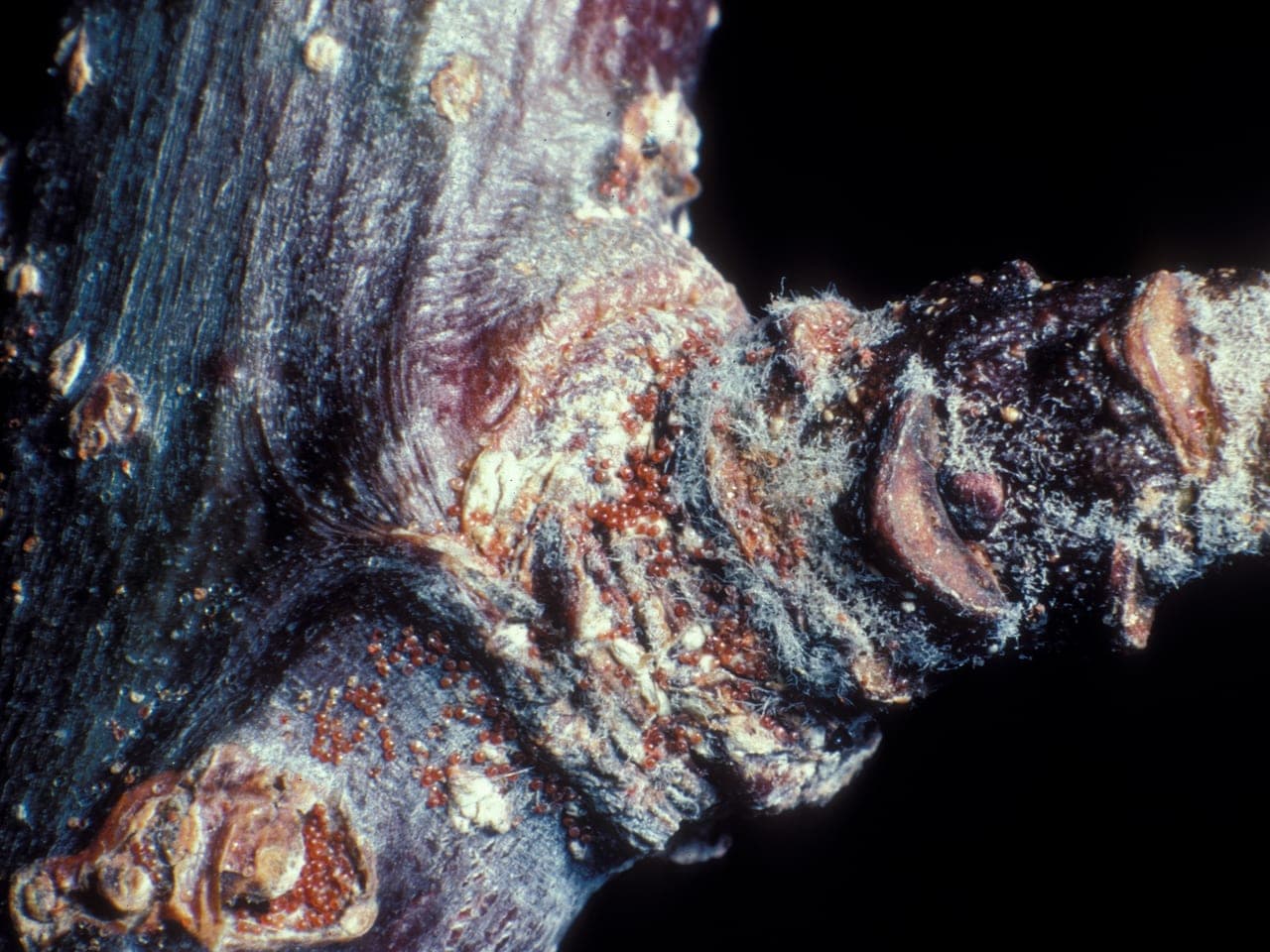
Overwintering eggs on bark. This is the stage dormant oil is aimed at, and the reason a winter application pays off.
How to be sure: Hold a sheet of white paper under a branch and rap the branch sharply. Mites show up as moving specks the size of ground pepper. Dust does not walk.
Trees it affects in Kansas
Also affects: Spruce, Arborvitae, Juniper, Burning bush, Roses.
When it happens in Kansas
April – early June
Spruce spider mite, a cool-season species, does its damage on conifers now. By the time the browning is obvious in July the mites have often already gone quiet.
July – August
Warm-season mites — twospotted and its relatives — build explosively on deciduous trees and shrubs during hot dry spells. Generations turn over in about a week.
September – October
Cool-season conifer mites become active again as temperatures drop. A second round of conifer damage often gets blamed on the summer heat.
Winter
Eggs overwinter on bark and needles. A dormant oil application reaches them where nothing in season easily can.
Prevention
- Hose down conifers and shrubs during hot dry stretches — mites do badly in humidity and physical disturbance
- Keep plants watered, since drought stress and mite outbreaks arrive together and reinforce each other
- Avoid routine broad-spectrum insecticide, which kills predatory mites and is the single most common cause of a mite flare-up
- Keep plants out of the dusty margin of a gravel drive where you have a choice
Treatment options
What you can do yourself
Water, applied forcefullyDuring any active infestation
A strong jet aimed up into the foliage dislodges mites and raises humidity in the canopy. Repeat every few days through a hot spell. On shrubs and small trees this alone often ends it.
Insecticidal soap or horticultural oilTwo or three applications five to seven days apart
Works on contact and spares most predators. Coverage has to include leaf undersides and the interior of the plant, and repeat applications are needed because eggs are not affected.
Dormant oilLate winter before bud break
Smothers overwintering eggs on conifers, which is often the most efficient point in the whole cycle to intervene.
What treatment actually achieves
The most important thing to get right is what not to do. A general-purpose insecticide typically leaves the mites alive, kills the predatory mites that were eating them, and produces a far worse outbreak two weeks later. Water and soap solve most cases; if you escalate, escalate to something labelled for mites specifically.
When the tree may not be recoverable
- A conifer browned to bare wood over most of its height — needles lost from old wood do not come back
- Repeated severe defoliation over several summers on a plant already struggling with drought or poor siting
- Deciduous trees essentially always recover; if one does not, the mites were a symptom and something else is the cause
Common questions
My spruce is browning from the inside out. Is this mites?
It is one of the likeliest causes, particularly if it appeared in spring or autumn rather than midsummer. Do the white-paper tap test on an affected branch before treating anything — the answer takes about thirty seconds.
I sprayed and it got dramatically worse. What happened?
You almost certainly killed the predatory mites. They reproduce more slowly than the pest mites, so removing them hands the plant over. This is a well-documented effect and it is the main reason mite outbreaks are often self-inflicted.
Will the brown needles turn green again?
No. Damaged needles stay damaged and eventually drop. What you are looking for is healthy new growth at the tips next season, which tells you the plant is recovering even though the old damage is still visible.
Kansas Tree Guide is an independent educational resource. Nothing on this site replaces an on-site assessment by a qualified arborist or tree-care professional. Last reviewed August 2026.