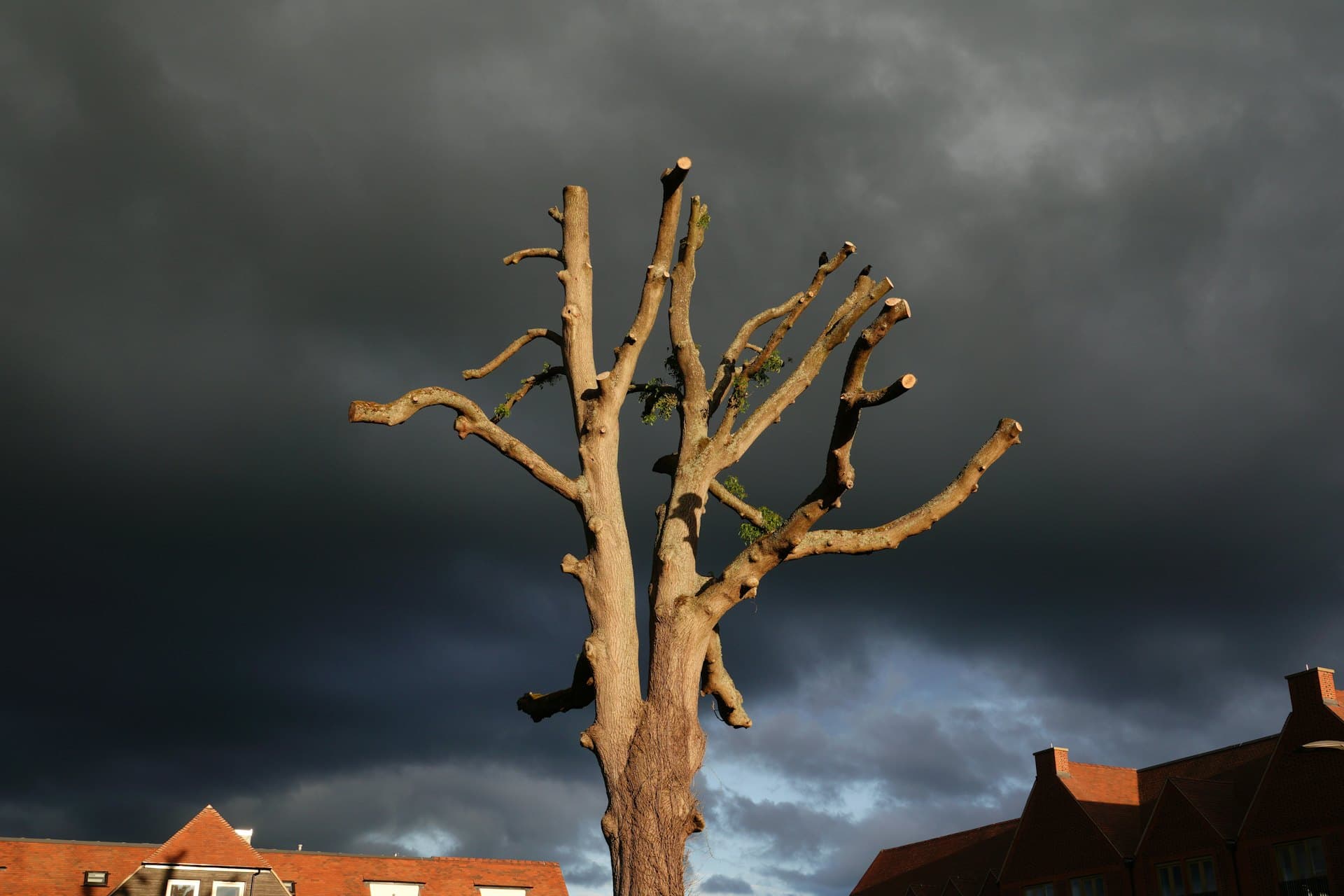
Storm season in Wichita brings the same request to tree crews every year. A big silver maple or cottonwood leans over the house, the homeowner has watched it thrash through a June thunderstorm, and someone offers to take the top out so it can no longer reach the roof. Tree topping — cutting a tree's main stems back to stubs to make it shorter — feels like the cautious choice. In Kansas wind and ice, it reliably turns out to be the opposite.
The damage runs on the same slow schedule as the other failures in this series. Nothing much happens the first summer. By the third, the tree looks bushy and vigorous. The danger arrives ten to fifteen years later, at close to the height the cut was meant to remove and on a weaker frame than the one it replaced. Once the mechanism is clear, the alternatives — which exist, and usually cost less over the life of the tree — are easy to ask for by name.
What tree topping is — and what it gets called on a quote
Topping is the reduction of a tree's size by cutting its leaders and large limbs back to stubs, or to side branches far too small to take over as the new top. The cuts land wherever the crew has decided the crown should end, rather than where the tree's own structure offers a place to cut. That is the defining feature, and it is the one worth remembering, because the word itself rarely appears on the paperwork.
It also goes by hat-racking, rounding over, dehorning, "taking it down by a third," "cutting it back so it comes in fuller," and, after a big storm, "storm-proofing." The test is not the name. Ask where each cut will land. If the answer is a height — "we'll bring it down to about the roofline" — it is topping. If the answer is a branch — each limb shortened back to a living side branch, or removed at the trunk — it is something else.
The tree-care profession is unusually blunt about this one. The International Society of Arboriculture calls topping perhaps the most harmful pruning practice there is, and the ANSI A300 pruning standard that professional tree work in the United States is written against lists it among the practices that are not acceptable. That is why the hiring checklist on our Kansas resources page treats an offer to top a healthy tree as the clearest signal to stop.
Two things look similar and are not the same. Pollarding is a deliberate system begun on a young tree and repeated every year or two at the same knuckles, so the cuts never reach large wood; it is rare in Kansas yards, and it is never what a crew means when it offers to top a mature maple. Utility line clearance can leave a stark V- or L-shaped gap in a crown, but it is done by cutting back to branches growing away from the wire, or to the trunk, rather than through the middle of a limb. Anything near a power line is the utility's call before it is anyone else's.
Why a topping cut never closes
Where a branch joins a larger stem, the tree has built a junction with its defenses already in place. The swollen ring of bark and wood at the base of a branch — the branch collar — contains tissue that walls off decay when the branch is lost, and a proper pruning cut is made just outside it so that defense can do its job. A cut through the middle of a limb has none of this. There is no collar to seal against, and the stub left above the nearest bud has no reason to stay alive.
So the stub dies back, and the exposed wood at its end becomes an open door. Decay fungi move down into the limb from the cut, and the tree's ability to wall them off — limited at best across a wound that size — loses ground every year. Topping cuts are large by definition, often several inches to a foot across on a mature tree, and larger wounds both close more slowly and admit more decay. The fast-growing species most often topped in Kansas — silver maple, Siberian elm, and cottonwood — are also among the poorest at containing it.
The bill comes due decades later. Across older Kansas neighborhoods, trees topped in the 1980s and 1990s are the ones hollowing from old cuts today: a flat stub high in the crown, a ring of sprouts around it, and decay tracking down the stem below.
The regrowth is the real hazard
A topped tree does not stay short. Dormant buds just below each cut break all at once, and within a season a single stub can carry a dense cluster of upright shoots. On a silver maple or an elm those shoots add several feet a year, and a fast-growing tree is commonly back near its old height within a few years — now carrying a crown far denser than the one that was removed.
What matters is how those shoots are attached. A natural branch grows from the core of its parent stem, with new wood laid down around the junction every year. A sprout from a topping cut forms in the outer layers of wood only, so it is anchored shallowly — and it is anchored to a stub that, as the previous section explains, is decaying underneath it. Ten to fifteen years on, those sprouts are the size of limbs, crowded together, poorly attached, and sitting on rotten wood.
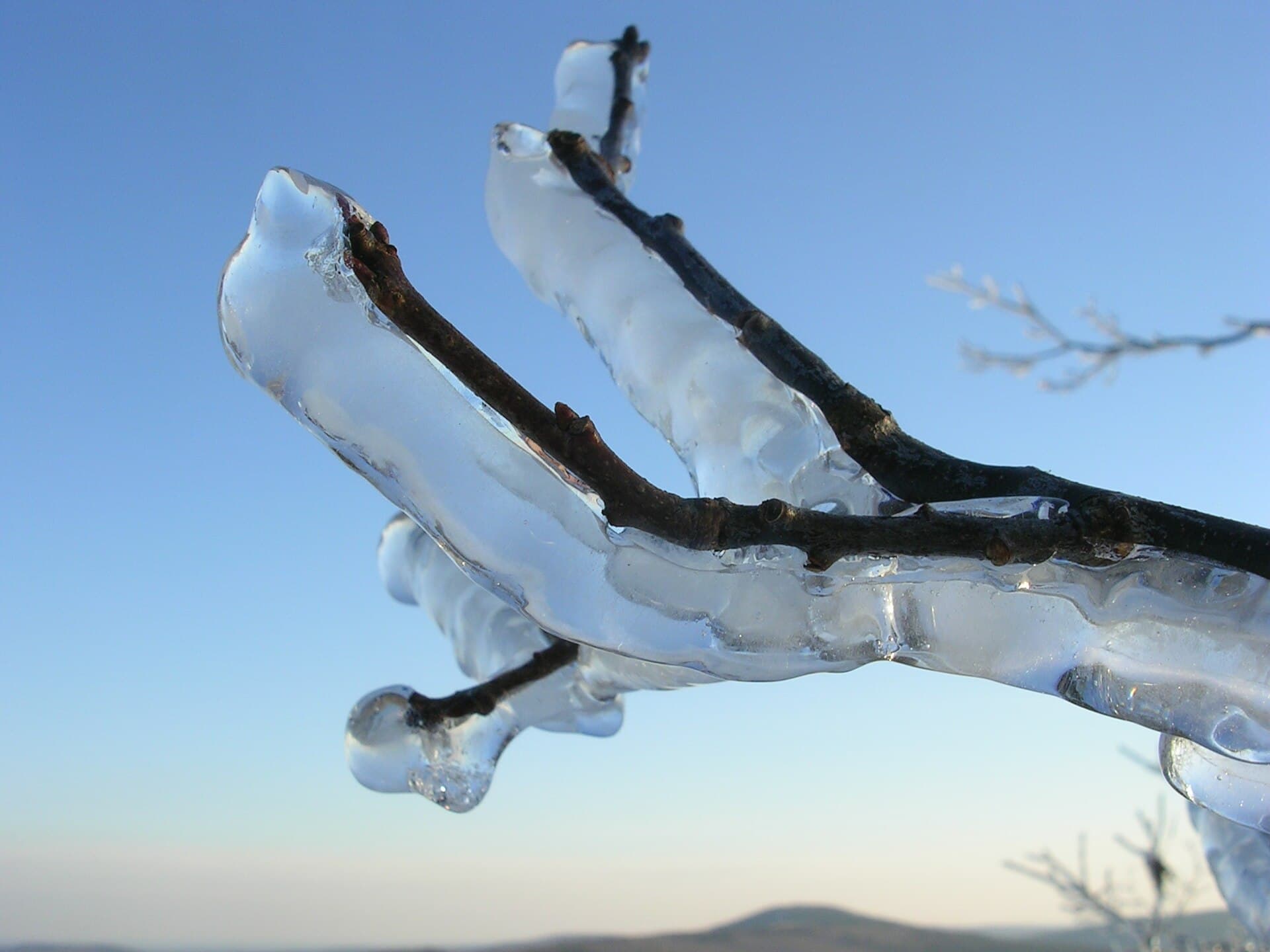
That is exactly the structure Kansas weather finds. A dense crown of upright sprouts catches more wind than an open natural crown, and in an ice storm it collects load on a huge number of fine twigs held out on weak joints — which is why a topped tree is a permanent ice-storm liability. When sprouts fail, they tend to go together, in clusters, at the same point, and they are a common source of broken limbs left hanging in a canopy after a summer storm.
So the cut that was supposed to remove the risk resets the clock with a worse structure. Topping also has to be repeated every few years to hold the height down, and each round cuts into larger, more decayed wood than the last. A topped tree becomes a recurring bill, then a hazard, then a removal — and often a harder removal than the original tree would have been, because decayed stubs and weakly attached sprouts give a climber very little to tie into.
What the first summer costs the tree
Topping removes leaves, and leaves are where a tree makes its food. The International Society of Arboriculture notes that topping can remove 50 to 100 percent of a tree's leaf-bearing crown. The tree responds by spending stored reserves to push emergency shoots — the same reserve it would otherwise use to close wounds, fend off insects, and ride out a dry spell. It is the mechanism behind how drought kills Kansas trees, set off with a saw, and a tree topped going into a hot, dry Kansas summer is drawing on that reserve twice.
A weakened tree is the one pests choose. Borers colonize stressed trees and largely ignore vigorous ones a few yards away, and several canker fungi take hold only once a tree's defenses drop. Dozens of large fresh wounds give both an easier way in.
Then there is the sun. Bark that grew up shaded inside a full canopy is suddenly exposed to Kansas summer sun and to the low, bright winter sun from the southwest. Thin-barked trees — maples especially — can scald, split, and lose bark along the upper sides of exposed limbs, the same southwest injury that damages young trunks.
Some trees do not survive the cut at all. Older trees have far less capacity to resprout, and conifers cannot grow new shoots from bare wood: topping an Austrian pine or a spruce below its foliage leaves a stub that never regrows — at best a flat-topped tree, at worst a dead one.
Why people top trees in Kansas, and what answers each reason
Almost nobody tops a tree out of carelessness. The request usually comes from a reasonable worry with the wrong fix attached, and each of the common worries has a better answer.
"It's too tall, and I'm afraid it will fall on the house." Height is not what makes a tree dangerous; defects are. Decay, cracks, weak forks, root damage, and a lean that has changed are what bring trees down onto houses, and a tall, sound tree is safer than a short topped one. The useful step is having those defects looked for. The tree health checklist walks through what you can see from the ground, and cracks in the trunk or a lean that is new are the signs that justify a professional look soon.
"The branches hang over the roof." That is a clearance job, not a height job. Specific limbs are shortened back to a side branch or removed at the trunk to give roughly eight to ten feet of clearance, and the rest of the crown is left alone. The pruning section of our tree care guide covers how it should be done.
"It's growing into the power lines." That one is not yours to solve, and not a general tree crew's either. Call the utility — Evergy across most of the Wichita area — and let line clearance handle it. The permanent fix is planting nothing under a distribution line that matures taller than about 25 feet.
"The storm took half of it — just even it up." A storm-damaged tree needs its broken stubs cut back to proper cuts at a branch or the trunk, and nothing more until it has leafed out and shown what survived. Topping the rest to match turns a damaged tree into a permanently weak one. The storm damage assessment helps sort out what needs attention now and what can wait.
"It drops too much and shades everything." Light thinning, or raising the lower crown, can let in light. But if the real problem is that the species is wrong for the spot — a cottonwood beside a patio, a silver maple a few feet from the foundation — no amount of cutting will change that, and replacement is the honest answer.
What to ask for instead of tree topping
When a tree genuinely needs to be smaller, the professional technique is crown reduction, done with reduction cuts. Each leader or limb is shortened back to a living lateral branch at least one-third the diameter of the stem being removed. That lateral is large enough to take over as the new tip, the cut sits at a junction the tree can defend, and the result still looks like a tree — a somewhat smaller one — rather than a hat rack.
Reduction has limits, and an honest crew will say so. On a mature tree, plan on removing no more than about a quarter of the live foliage in a season, and less on old or stressed trees. That shortens the reach and end weight of specific limbs; it does not turn a sixty-foot cottonwood into a twenty-five-foot one. If a tree has to lose half its height to fit its space, the space is saying it was the wrong tree, and removal with a right-sized replacement is the better job. The planting guides and the planting distance calculator help get the replacement right.
Young trees get the cheapest answer of all: structural pruning in their first fifteen years, taking out a competing leader or shortening an overlong limb while the cut is the size of a thumb. Most of the trees being topped in Kansas today were candidates for a few small cuts twenty years ago.
Then put the scope in writing, in tree terms. A good written scope names which limbs are being reduced or removed and roughly how much, specifies reduction cuts to laterals at least one-third the diameter of the cut, and references the ANSI A300 pruning standard. It should not involve climbing spikes on a tree you are keeping, since spikes wound the trunk with every step. Ask for an ISA Certified Arborist and check the credential by name — the Kansas resources page lists the other questions worth asking before anyone starts.
When to prune in Kansas: oaks, elms, and the dormant season
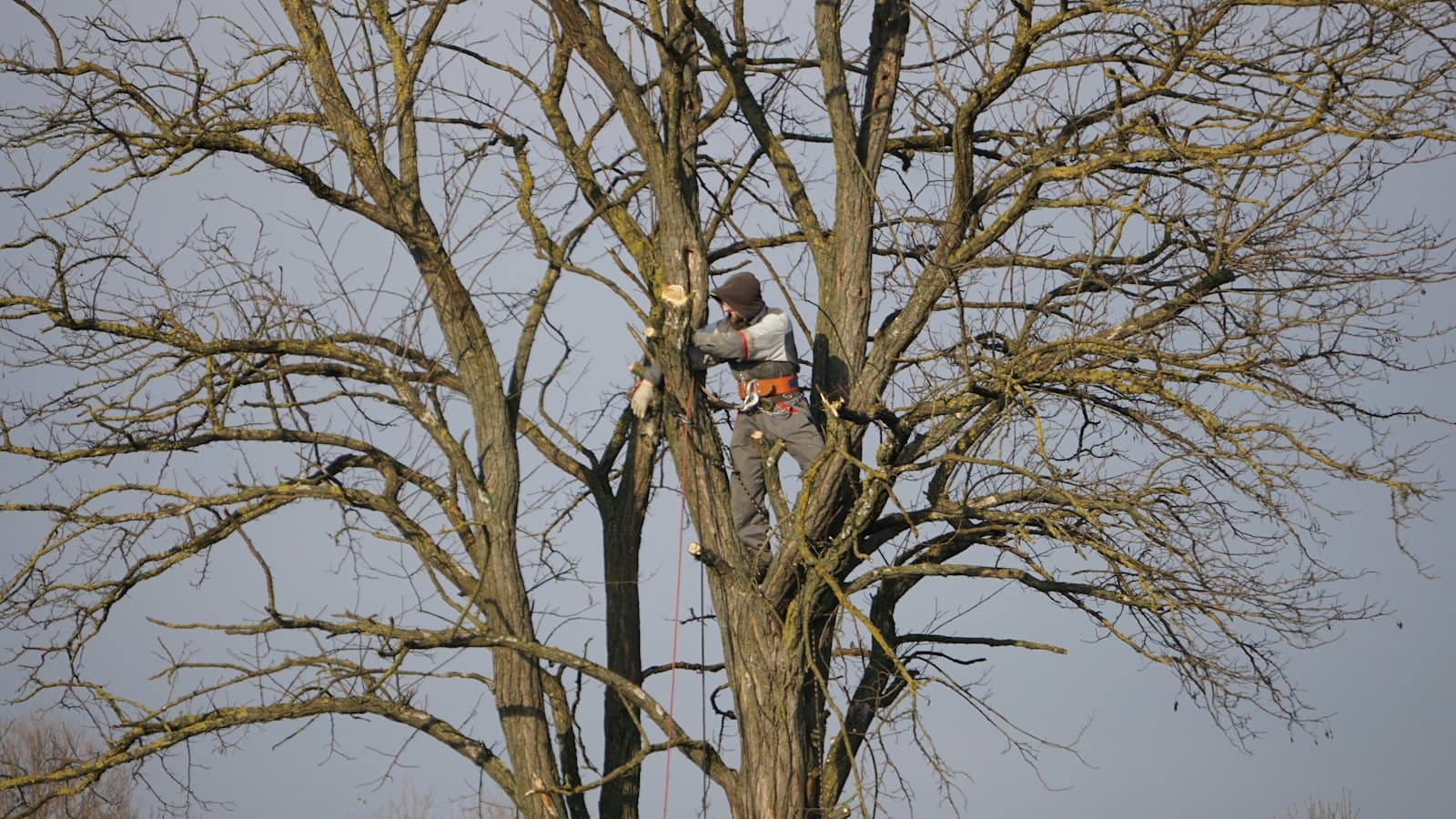
Timing matters more for large cuts than small ones. Late fall through winter, roughly November to February, suits nearly every Kansas tree: the structure is visible with the leaves down, the insects that carry disease are inactive, and wounds start closing as soon as growth resumes in spring. The seasonal pruning calendar sorts out the exceptions by species.
Two of those exceptions are firm. Oaks should not be pruned between April 1 and July 1, when the sap beetles that carry oak wilt are flying and are drawn to fresh wounds within hours — and topping an oak in spring opens dozens of large fresh wounds at once, close to the worst thing that can happen to it. Elms belong in winter for the same reason with Dutch elm disease. Redbud and other spring-flowering trees are best pruned right after they bloom, or next year's flowers go with the cut.
Wound paint is not part of routine pruning. Trees close well-placed cuts on their own, and sealants can hold moisture against the wood. The Kansas exception is an oak that has to be cut, or is damaged, during the oak wilt window, where painting the wound immediately is the recommended step.
If your tree has already been topped
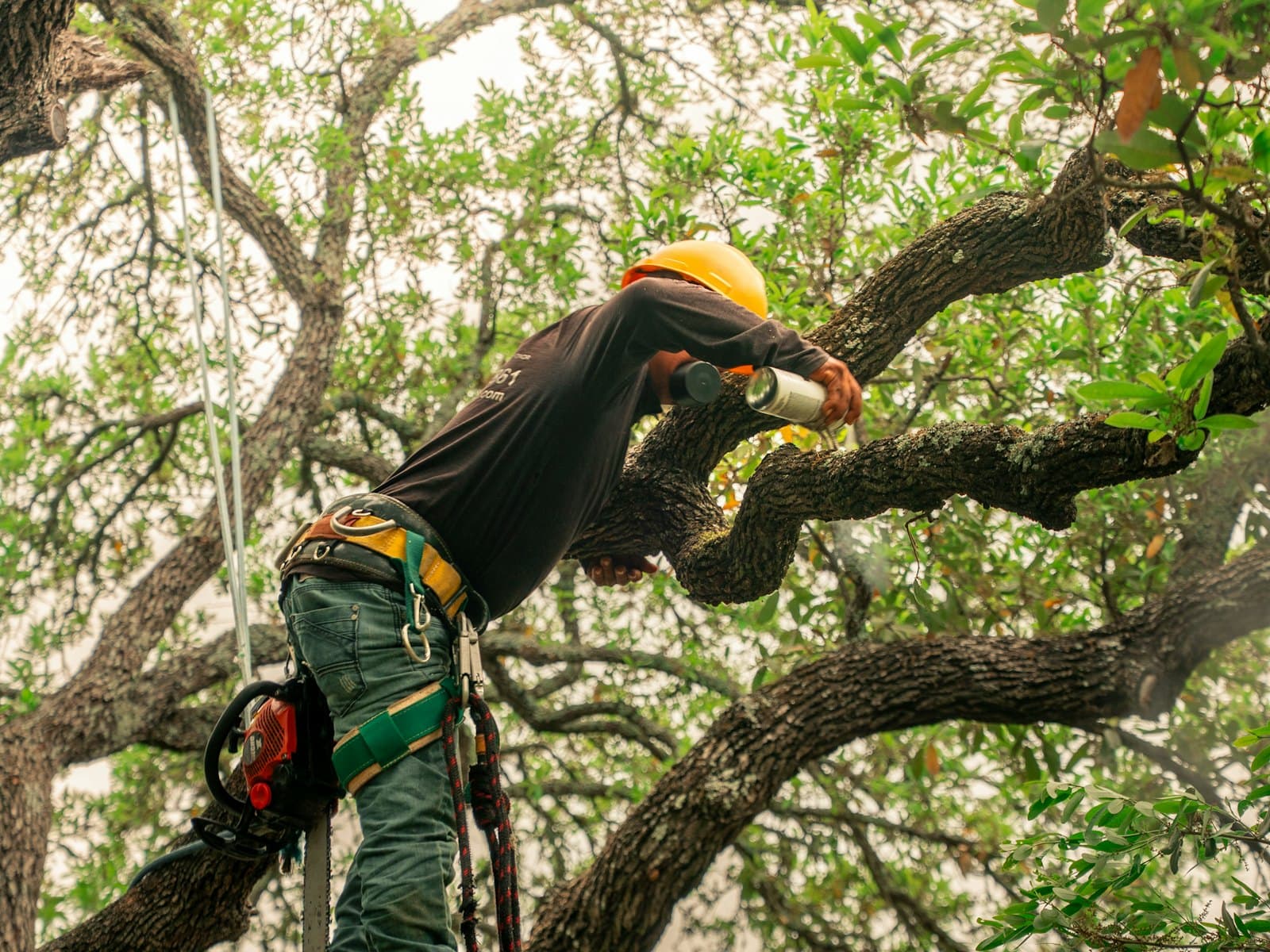
A topped tree is not automatically a removal. What it needs depends on how long ago the cuts were made, on the species, and above all on what has happened inside the old stubs.
Restoration pruning is the route back toward a sound structure. Over several dormant seasons, an arborist chooses one to three of the strongest, best-placed sprouts at each old cut to become new limbs, then removes or shortens the competitors around them so the chosen ones can thicken. It has to happen gradually — taking out every sprout in a single visit is simply topping the tree a second time — and it usually runs to several rounds over a number of years.
The stubs decide whether that effort is worth making. A cavity at an old cut, soft or punky wood, fungal conks on the stem below, or sprouts that have already broken out at their bases all mean the attachment points are failing, and no amount of careful selection fixes rotten wood. Mushrooms at the base change the question again, from pruning to whether the tree is still stable.
Sometimes the honest answer is replacement. A heavily topped silver maple or Siberian elm with decayed stubs over the house or the driveway is usually a better removal than a restoration project, and every year of regrowth makes the eventual job larger. If the tree stands in the strip between the sidewalk and the street, find out whose tree it is before anyone cuts it, because many Kansas cities own those trees and control who prunes them. Whatever you decide, do not put it back on a topping schedule.
Common questions
Is tree topping ever acceptable?
Is tree topping ever acceptable?
Not for a tree you intend to keep. The ANSI A300 pruning standard lists topping among the practices that are not acceptable, and no qualified arborist recommends it as maintenance. Pollarding — a system started on a young tree and repeated every year or two at the same points — is a different practice, and utility line clearance cuts back to branches rather than through the middle of limbs. If a tree has to become dramatically shorter to fit its space, removing it and replanting with a smaller species is the sound version of the same decision.
Will topping stop my tree from falling on the house in a storm?
Will topping stop my tree from falling on the house in a storm?
No, and over time it makes a failure more likely. Height alone is not what brings trees down; decay, weak forks, root damage, and lean are. Topping adds decay at every cut and replaces sound limbs with dense, weakly attached sprouts that catch more wind and ice, and within a few years a fast-growing Kansas tree is usually back near its old height on that weaker structure. If a tree near the house worries you, have its defects assessed. A sound tall tree can be left alone; a defective one may need specific limbs reduced, or may need to come down.
How much can safely be cut off a mature tree?
How much can safely be cut off a mature tree?
As a working limit, no more than about a quarter of the live foliage in one season, and less on old, stressed, or recently damaged trees. Size should come down through reduction cuts — each limb shortened back to a side branch at least one-third its diameter — never by cutting everything back to a set height. If getting the tree to the size you need would take far more than that, it is too big for its spot, and replacement is worth pricing alongside the pruning.
How can I tell whether a tree service quote is really for topping?
How can I tell whether a tree service quote is really for topping?
Ask where each cut will be made. If the answer is a height — down to the roofline, down by a third, back to a certain point — it is topping, whatever the quote calls it. If the answer is a branch — each limb shortened to a living side branch or removed at the trunk — it is reduction or clearance pruning. A written scope that names reduction cuts to laterals and references the ANSI A300 standard is a good sign; hat-racking, rounding over, and "cutting it back so it comes in fuller" are not.
Worried about a big tree in the Wichita area?
For a tree over the house or driveway, the useful next step is an on-site look from someone who can tell height from hazard — and who will put reduction cuts, not a height, in the written scope. Kohnen's Tree Service provides pruning and arborist assessments across Wichita and the surrounding communities, and does not top trees.
When a situation calls for professional help in the Wichita area, we refer readers to Kohnen's Tree Service, a working Kansas tree-care company whose field experience informs this site. That relationship is disclosed here and on our About page.
Kansas Tree Guide is an independent educational resource. Nothing on this site replaces an on-site assessment by a qualified arborist or tree-care professional. Last reviewed August 2026.