
Oak wilt
Bretziella fagacearum
A fungal disease that plugs the water-conducting vessels of an oak from the inside. Red oaks can go from healthy to dead in a single season, and because it also travels underground through grafted roots, one infected tree threatens every oak near it.
Usually fatal. Once established in a susceptible tree, this generally ends in removal. Effort is better spent protecting the trees nearby than saving the one already infected.
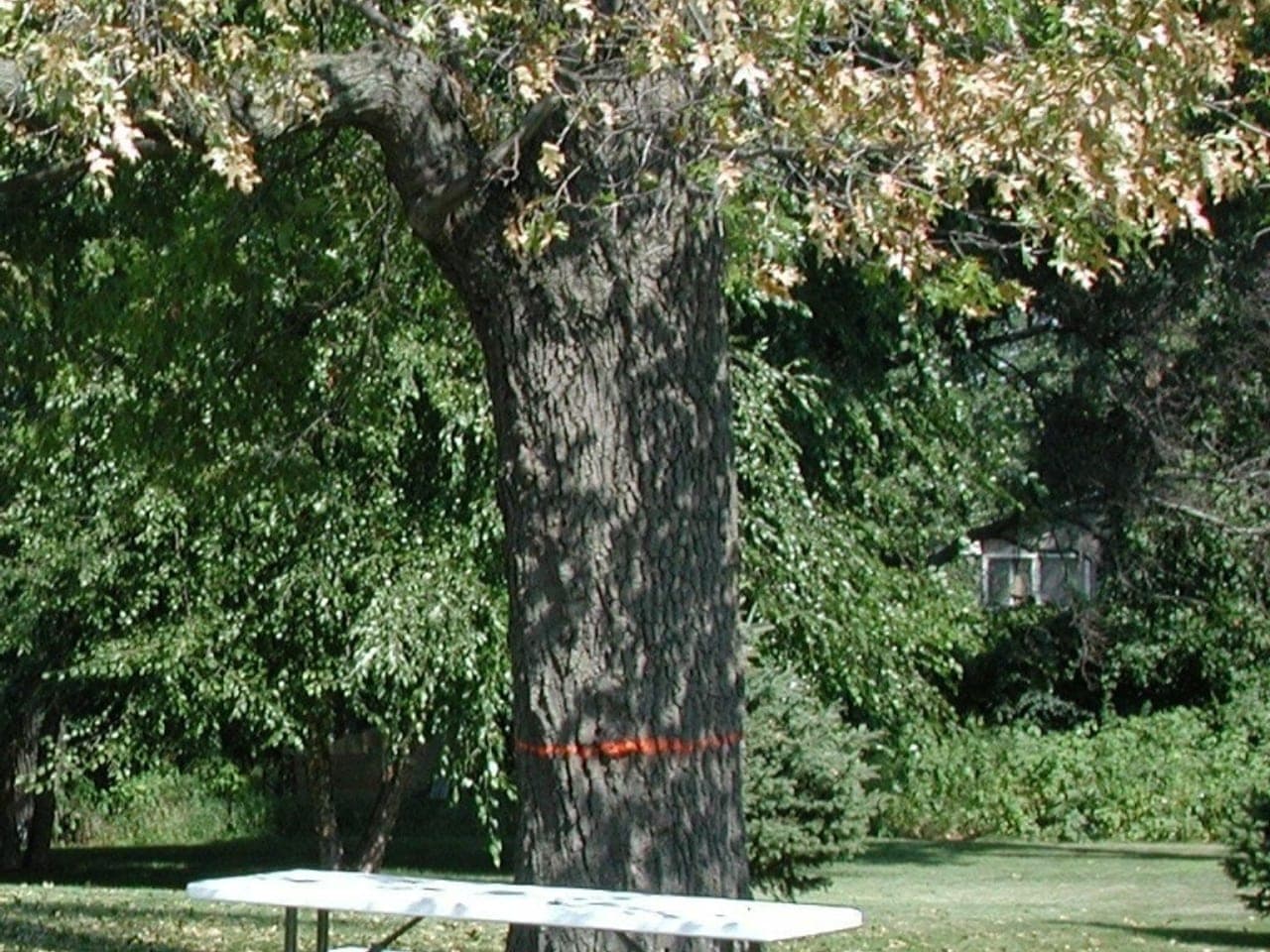
What you see
- Leaves browning from the tip and outer margin inward while the base stays green
- Rapid leaf drop in early summer, with green or half-green leaves falling
- Wilting that starts at the top of the canopy and sweeps downward over weeks
- In red oaks, most of the canopy lost in a single season
- Dark streaking in the sapwood just under the bark of a wilted branch
- Cracked bark over a sweet-smelling fungal mat, most often on red oaks the season after death
- Neighbouring oaks declining in sequence outward from the first tree
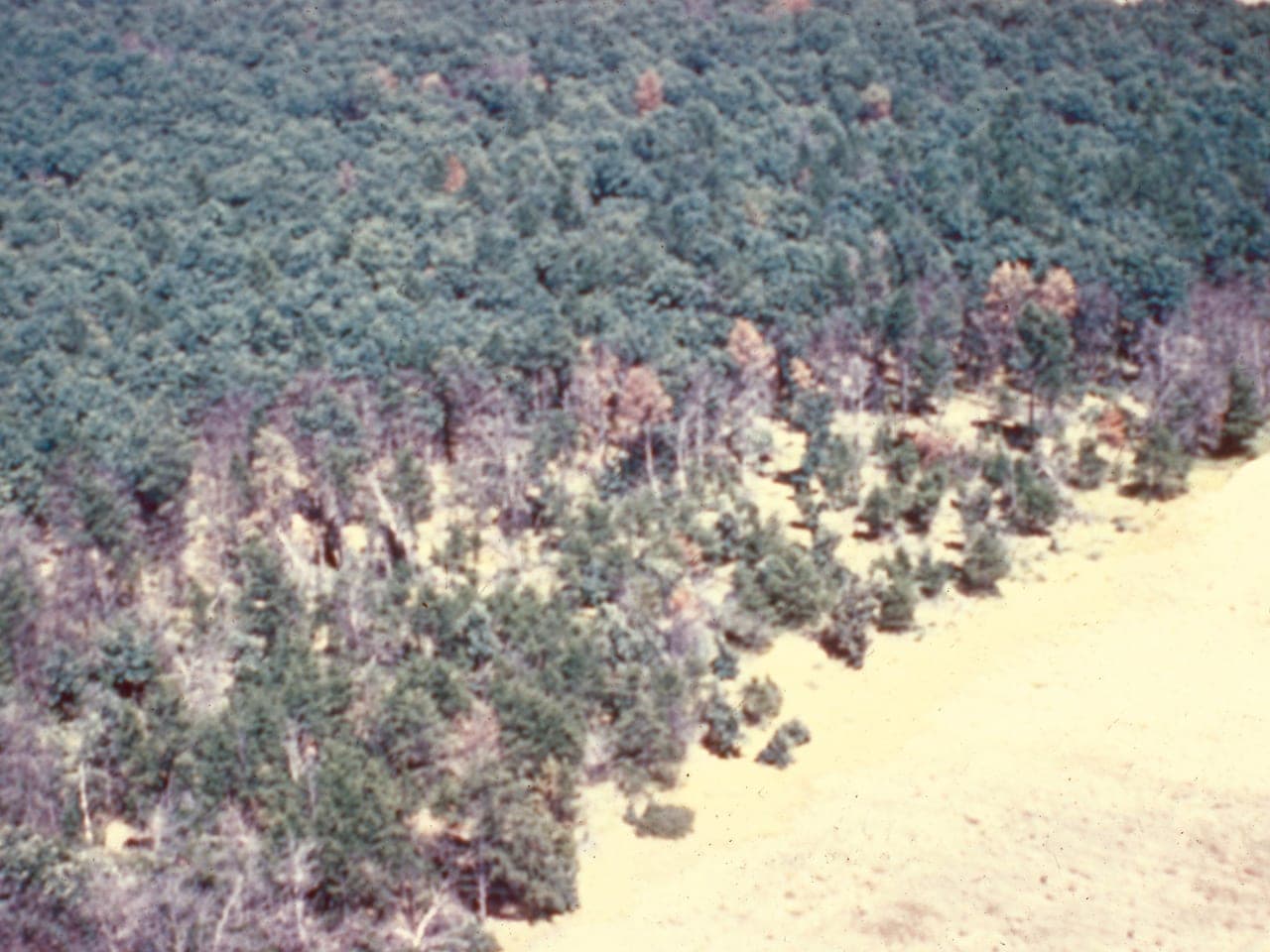
An oak wilt pocket seen from above. The expanding circle is the disease moving through connected root systems, not through the air.
How to be sure: Speed and direction. Oak wilt browns leaves from the margin inward and takes a red oak down in weeks to a season — a rate no other Kansas oak problem matches.
Trees it affects in Kansas
Also affects: Black oak, Blackjack oak, Shingle oak, Chinkapin oak, White oak.
When it happens in Kansas
April 1 – July 1
The critical window. Sap beetles carrying spores are flying and are drawn to fresh wounds. An oak pruned, damaged, or struck now can be infected within hours. Do not prune oaks during this period for any reason short of a safety hazard.
May – July
Symptoms appear in infected trees. Red oaks wilt fast; the whole canopy can go in three to six weeks.
Summer – fall
The fungus moves underground through root grafts between neighbouring oaks, which is how it takes out a group rather than a single tree.
Fall – winter
The safe window for any oak pruning that needs doing. Fungal mats form under the bark of trees that died in the previous season.
Prevention
- Do not prune, wound, or climb-spike oaks between April and July — this single rule prevents most new infections
- If an oak is damaged in that window by a storm or an accident, paint the wound immediately, which is the one situation where wound paint is genuinely recommended
- Never move or store unseasoned red oak firewood from a tree that died suddenly, and do not stack it against healthy oaks
- Have suspected infections confirmed by laboratory testing before acting, since several other problems mimic it
- Consider severing root grafts between an infected oak and its healthy neighbours before removing the infected tree
Treatment options
What you can do yourself
Correct pruning timingNovember through February
Free, and more effective than anything on this list. Schedule all oak work for the dormant season and hold the line on it even when a contractor offers to do it in June.
What treatment actually achieves
There is no cure for a red oak that is already wilting. Everything effective is either preventive or aimed at the trees not yet infected, which makes oak wilt one of the few tree problems where the right response is to stop thinking about the sick tree and start protecting its neighbours. The white oak group — bur oak most importantly in Kansas — is meaningfully more resistant and sometimes survives, which is worth knowing before anybody recommends removing a bur oak.
When the tree may not be recoverable
- A red oak, pin oak, or black oak with more than about a third of the canopy wilted — these rarely survive the season
- Wilt that has swept the full canopy within one growing season
- Fungal mats forming under cracked bark, which means the tree is dead and is now a spore source for the whole block
- Bur oak and other white oaks are the exception worth testing before giving up on: they can decline slowly for years and some recover
Need professional help in the Wichita area?
Oak wilt usually ends in removal, and a dead tree near a house, drive, or play area is a structural problem rather than a horticultural one. A professional assessment settles both questions at once.
When a situation calls for professional help in the Wichita area, we refer readers to Kohnen's Tree Service, a working Kansas tree-care company whose field experience informs this site. That relationship is disclosed here and on our About page.
Common questions
My oak dropped green leaves in June. Should I worry?
It is worth taking seriously, because shedding green and half-green leaves in early summer is characteristic of oak wilt and of very little else. Get a proper diagnosis quickly — with oak wilt the value of acting early is unusually high, because it decides whether the neighbouring oaks survive.
Is it really that important not to prune oaks in spring?
Yes. It is the most consequential piece of tree-care timing in Kansas. Beetles carrying oak wilt spores are attracted to fresh cuts within hours, and a single spring pruning job has been enough to introduce the disease to a property.
Can I keep the firewood from an oak that died?
Not from a red oak that died suddenly, unless you debark it or cover it fully through the following summer. Fungal mats form under the bark of that wood and produce the spores that start new infections.
Kansas Tree Guide is an independent educational resource. Nothing on this site replaces an on-site assessment by a qualified arborist or tree-care professional. Last reviewed August 2026.