Iron chlorosis
Yellowing caused not by a shortage of iron in Kansas soil but by soil too alkaline for the tree to take the iron up. It is the classic Kansas planting mistake made visible, and on the species that suffer it, the honest long-term answer is often a different tree.
Manageable. Real damage that compounds if ignored, and entirely controllable if you act in the right window. Timing matters more than product choice.
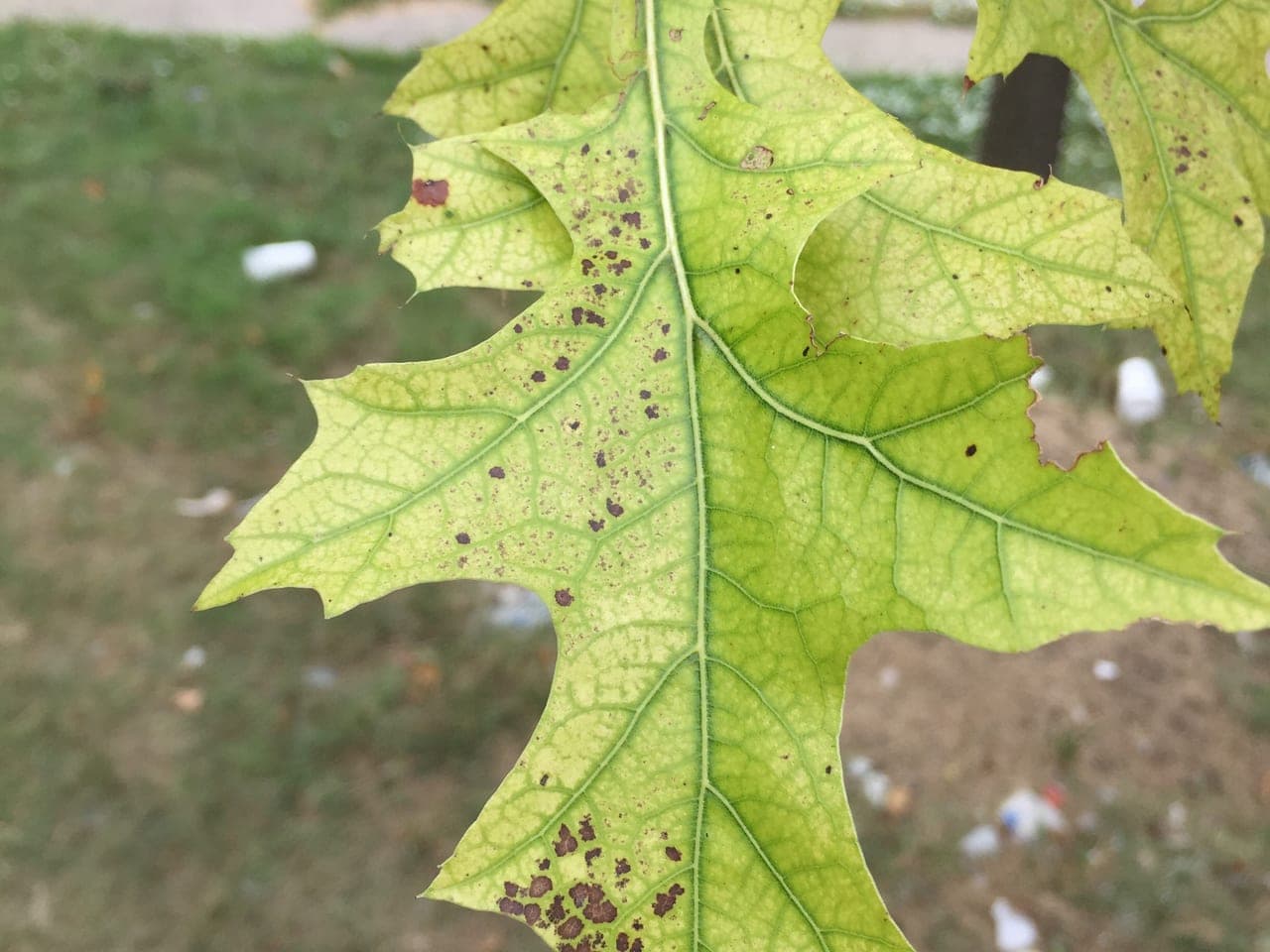
What you see
- Leaves yellow between the veins while the veins themselves stay distinctly green
- Newest leaves at branch tips affected first and worst
- In severe cases leaves turn nearly white, then scorch brown at the margins
- Symptoms worse on one side of a tree, or on trees nearest a foundation, drive, or old mortar
- Progressive twig dieback at the branch tips over several seasons
- Reduced leaf size and a generally thin, pale canopy
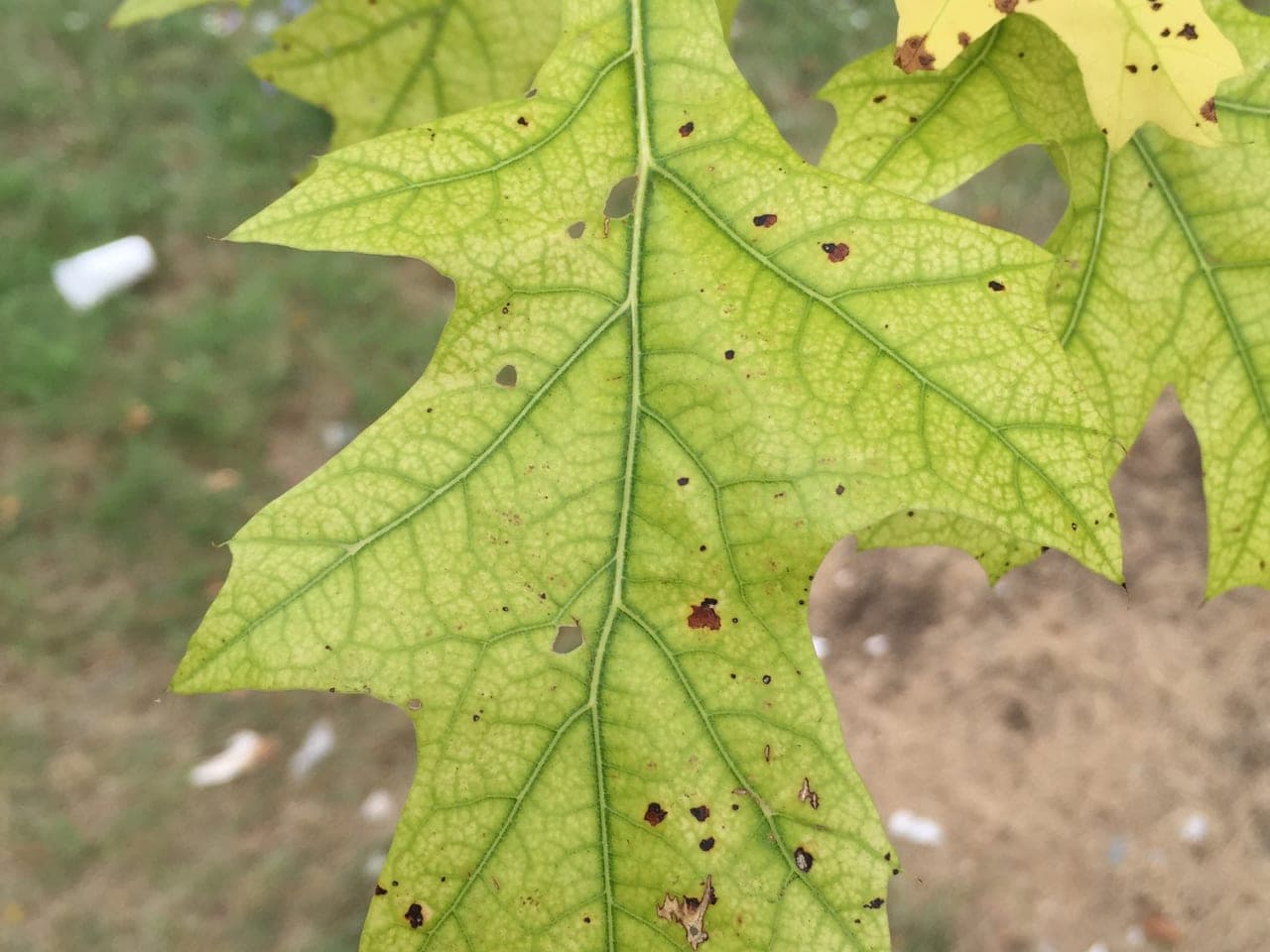
Further along. Once the tissue between the veins starts dying outright, the tree has been short of usable iron for several seasons. 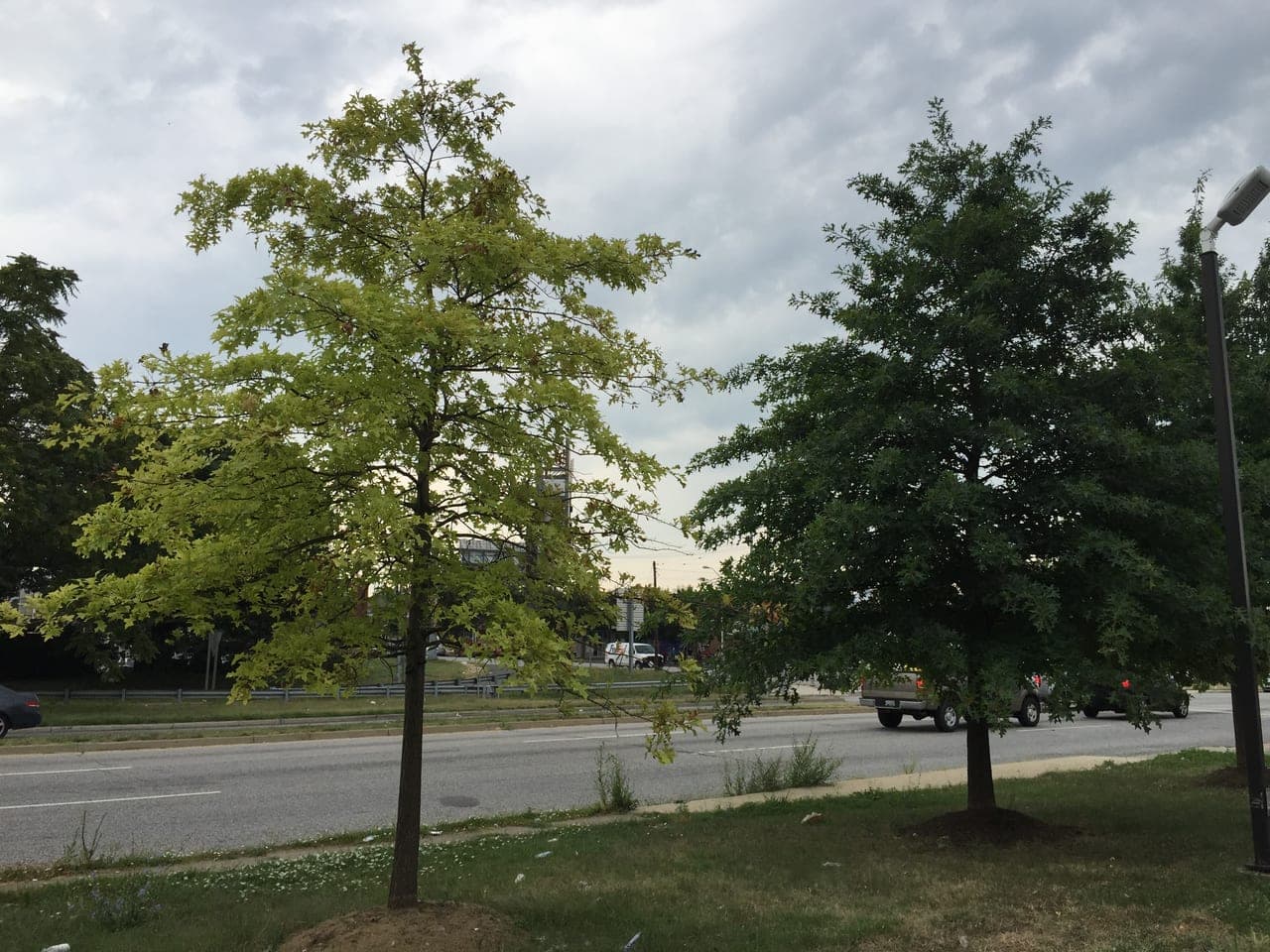
The same species, the same age, a few feet apart. This is a soil chemistry problem, not a disease.
How to be sure: The veins stay green while the tissue between them goes yellow. General yellowing with pale veins is a different problem — usually nitrogen, water, or roots.
Trees it affects in Kansas
Also affects: River birch, Sweetgum, Red maple, Baldcypress, Azalea and rhododendron.
When it happens in Kansas
May – June
First clearly visible as the new flush expands. Mild cases sometimes green up on their own as roots warm and soil dries.
July – August
Most pronounced, and often worse after heavy rain, since waterlogged soil further reduces iron availability.
Late summer
Marginal scorch and leaf drop in severe cases. Twig dieback becomes visible in trees that have been chlorotic for years.
Fall
The right time for a soil test and for the decision about whether this tree is in the wrong place. It is also the planting season, which is when that decision actually costs nothing.
Prevention
- Test your soil pH before planting rather than after — most of Kansas runs alkaline, frequently above 7.5
- Choose species suited to high-pH soil: bur oak, chinkapin oak, hackberry, honey locust, Kentucky coffeetree, catalpa
- Avoid pin oak, river birch, sweetgum, and red maple in alkaline ground no matter how good they look at the nursery
- Be especially careful within about ten feet of a foundation, drive, or old mortar, where construction lime pushes pH higher still
- Avoid overwatering and improve drainage, since saturated soil makes iron less available regardless of pH
Treatment options
What you can do yourself
Chelated iron with EDDHASpring, applied to the root zone and watered in
The chelate matters more than the iron. EDDHA-chelated iron stays available above pH 7.5; the cheaper EDTA products that dominate garden centre shelves do not, which is why so many people conclude iron treatment does not work.
Foliar iron sprayCool, overcast conditions during the growing season
Greens up treated leaves within a week or two, which is satisfying and completely temporary. It treats the leaves you sprayed and nothing else, so it is a stopgap for appearance rather than a fix.
Soil acidification with elemental sulphurFall, worked into the root zone
Works in theory and disappoints in practice on most Kansas soils, because the free lime in the soil buffers the pH straight back. Worth attempting on a small scale in a bed; not worth expecting much from under a mature tree.
Replacement with an adapted species
The genuinely permanent solution, and the one nobody wants to hear. A chronically chlorotic pin oak will need treating every few years for the rest of its life; a bur oak in the same hole never will.
What treatment actually achieves
Chlorosis is a soil problem being treated at the tree, which is why every treatment is a repeat subscription. Injections and chelates work and are worth it for an established shade tree you value — but none of them change the pH, so none of them end the problem. When the tree is small, or when you are choosing what to plant, the cheapest treatment available is choosing a different species.
When the tree may not be recoverable
- Years of severe chlorosis followed by progressive dieback through the scaffold branches
- More than about half the canopy thinned or dead, with leaves emerging nearly white each spring
- A tree that greens up after treatment and reverts within a single season, repeatedly, is telling you the site is wrong even though the tree is technically alive
- Chlorosis rarely kills quickly — the more common outcome is a tree that is never good, which is a different kind of decision
Need professional help in the Wichita area?
Soil-applied chelated iron is a homeowner job; trunk injection on a mature pin oak is not. Where injection is the right call in the Wichita area, Kohnen's Tree Service handles chlorosis correction as part of its plant health care work.
When a situation calls for professional help in the Wichita area, we refer readers to Kohnen's Tree Service, a working Kansas tree-care company whose field experience informs this site. That relationship is disclosed here and on our About page.
Common questions
Why does adding iron to the soil not fix it?
Because there is usually plenty of iron already there — it is chemically locked up at high pH and the roots cannot take it up. Adding more of the same unavailable form changes nothing. That is why the chelate type, specifically EDDHA, matters more than the iron content on the bag.
My pin oak has been yellow for years. Is it going to die?
Probably not quickly, but it is unlikely ever to be a good tree on alkaline soil. The realistic choice is between an ongoing treatment programme and planting a replacement now so it has a head start.
Could this be something other than iron?
Yes — manganese deficiency looks very similar and has the same underlying cause, and root damage, poor drainage, or a tree planted too deep can all produce yellowing. A soil test plus a look at the root flare is worth doing before spending on treatment.
Kansas Tree Guide is an independent educational resource. Nothing on this site replaces an on-site assessment by a qualified arborist or tree-care professional. Last reviewed August 2026.