
Scale insects
Insects that spend most of their life immobile under a waxy shell fixed to bark or leaves, looking far more like a growth than an animal. Heavy infestations cause branch dieback, and there is exactly one short window each year when they can be reached.
Manageable. Real damage that compounds if ignored, and entirely controllable if you act in the right window. Timing matters more than product choice.
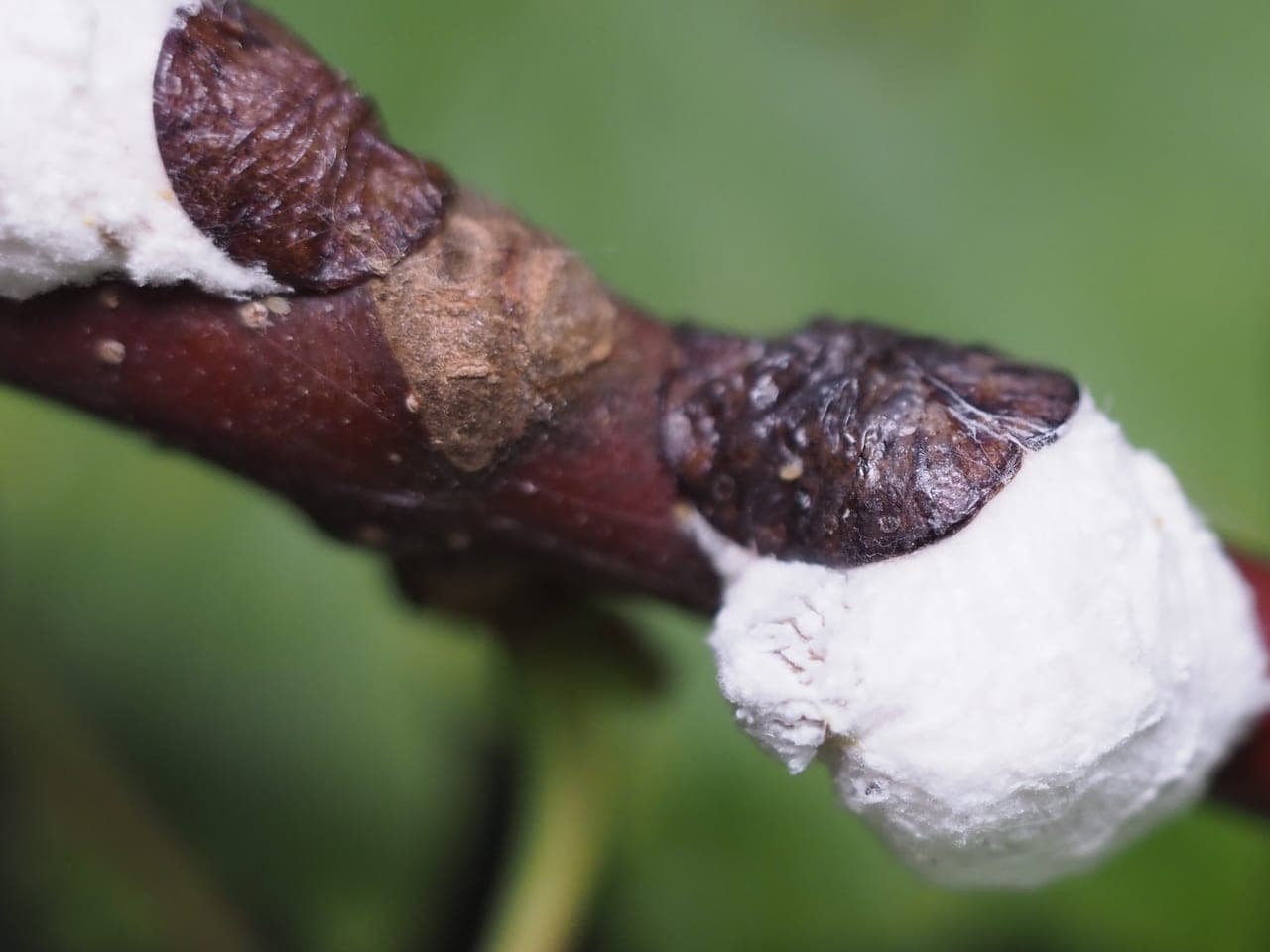
What you see
- Small bumps, blisters, or oystershell-shaped scabs stuck to twigs and small branches
- White cottony masses along the undersides of twigs in late spring
- Sticky honeydew and sooty mold, the same as aphids produce
- Yellowing foliage and thinning on individual branches rather than the whole canopy
- Twig and branch dieback progressing over two or three seasons
- Bark that looks textured or encrusted when you run a thumb along it
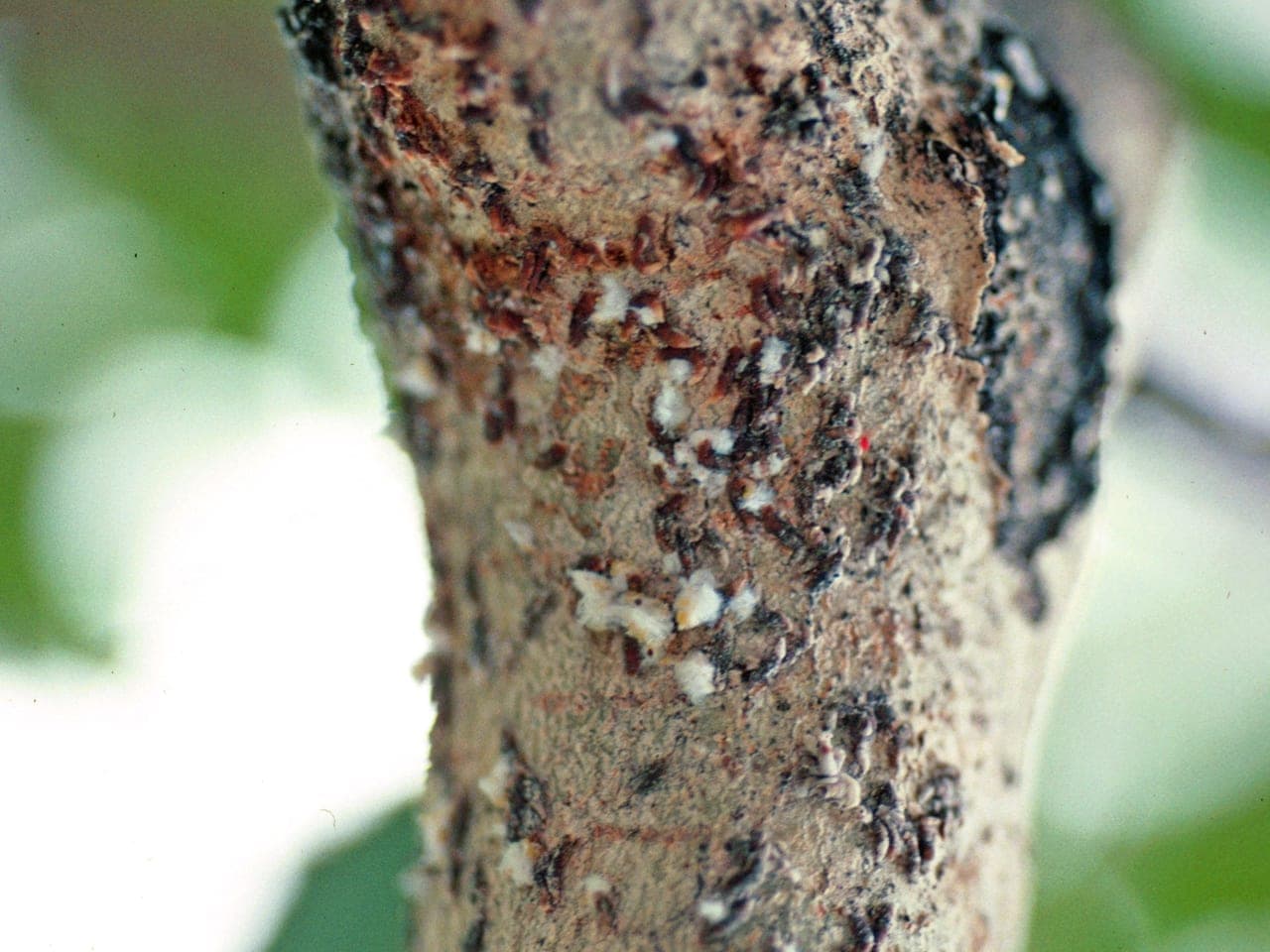
Oystershell scale packs the bark so densely it reads as texture. Each shell is one insect feeding underneath.
How to be sure: Scrape a bump sideways with a thumbnail. A scale pops off and leaves a soft insect body or a wet smear behind; a lenticel, gall, or bark feature does not.
Trees it affects in Kansas
Also affects: Magnolia, Euonymus, Lilac, Dogwood, Tulip poplar, Fruit trees.
When it happens in Kansas
Winter
Most species overwinter on the bark as immature scales or eggs, fully exposed and completely protected by their wax. Dormant oil is the one thing that gets through.
May – June
Eggs hatch into crawlers — the only mobile, unarmoured stage, and the only stage a contact insecticide can touch. The window for a given species is a couple of weeks at most.
Late spring
Cottony maple scale becomes conspicuous as females produce white egg masses on twig undersides. This is usually when people first notice the infestation, and it is right at the edge of the useful window.
Summer – fall
Settled scales feed under their covers, honeydew accumulates, and sooty mold follows. Spraying now achieves very little.
Prevention
- Inspect twigs on new nursery stock before planting, since scale arrives on plants far more often than it flies in
- Prune out and destroy heavily encrusted twigs rather than trying to spray them clean
- Keep trees watered — scale populations climb fastest on drought-stressed trees
- Avoid repeated broad-spectrum insecticide, which removes the parasitic wasps that hold most scale populations down
Treatment options
What you can do yourself
Dormant horticultural oilLate winter to bud swell, roughly February into March in Kansas
Smothers overwintering scales through their wax covering, which is why it works when nothing else does. Needs full coverage of twigs and branches, and a day above about forty degrees with no freeze coming.
Crawler-timed insecticidal soap or summer oilWhenever crawlers appear, usually mid-May into June
Effective only against the mobile crawler stage. Time it by wrapping a strip of double-sided tape around an infested twig and checking it every few days — treat when the tape starts catching tiny moving specks.
Pruning out infested woodDormant season
On a light, localized infestation this is a complete solution and requires no chemistry at all. Cut back to clean wood and remove the prunings from the site.
What treatment actually achieves
Scale is a timing problem wearing the disguise of a product problem. The armour that makes the insect conspicuous also makes it nearly immune for most of the year, so an application in July does almost nothing while the same product in the crawler window works well. If you take one thing away: put double-sided tape on a twig in May rather than guessing.
When the tree may not be recoverable
- Extensive branch dieback through the scaffold limbs after several years of untreated infestation
- A young or newly planted tree that has been encrusted to the point that the trunk itself is affected
- Scale is rarely the sole cause of death on a mature tree — when one dies, look for the drought, root damage, or planting depth problem underneath
Common questions
These bumps do not move. Are they really insects?
Yes. Adult scales lose their legs, fix themselves to the bark, and spend the rest of their life under a wax shell feeding on sap. Not moving is the strategy, not evidence against it.
What are the white cottony blobs on my maple twigs?
Almost certainly cottony maple scale. The cotton is an egg sac produced by the female in late spring. It looks dramatic and is rarely fatal, but a heavy year warrants a dormant oil application the following winter.
When exactly should I spray?
When the crawlers are out, which varies by species and by season. Tape a twig, watch for tiny moving specks, and treat then. A date on a calendar is a much worse guide than the tape.
Kansas Tree Guide is an independent educational resource. Nothing on this site replaces an on-site assessment by a qualified arborist or tree-care professional. Last reviewed August 2026.